
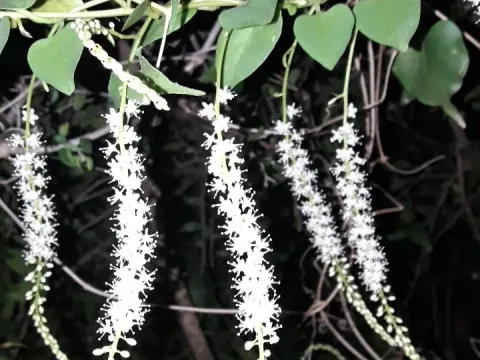
Boussingaultia
Boussingaultia
Boussingaultia, also known as Madeira vine, is a perennial climbing plant belonging to the Basellaceae family. In temperate regions, planting tubers or cuttings in open ground is strictly performed only after the threat of spring frost has completely passed.
What the section contains
Boussingaultia
The optimal time for growth initiation is when soil temperatures at a depth of 10 centimeters consistently exceed +15 degrees Celsius. To accelerate crop development in regions with short growing seasons, it is recommended to pre-sprout tubers in pots 4–6 weeks before planting.
Planting material is placed at a depth of 5–7 centimeters with a spacing of at least 30–40 centimeters between plants. This crop exhibits high growth vigor, so planting patterns must account for the necessity of installing sturdy trellises or supports for the climbing vines.
Propagation by seeds is possible in greenhouses during late winter, though this method is rarely used due to low seed viability and difficulty in obtaining quality material. Vegetative propagation via tubers remains the primary and most efficient method of cultivation.
Proper soil preparation is crucial; the site must be sheltered from strong winds and well-illuminated, as Boussingaultia is extremely sensitive to sunlight deficiency, which significantly slows down the accumulation of tuber mass.
The plant has high soil moisture requirements but categorically cannot tolerate waterlogging, which leads to rapid decay of the root system and young tubers. Ideal substrates are light, well-drained loams with a neutral or slightly acidic pH level.
Boussingaultia is a heat-loving crop: the optimal temperature range for active growth is between +20 and +30 degrees Celsius. At temperatures below +10 degrees, plant development almost completely stops, and sub-zero temperatures cause the death of the aerial parts.
Fertilization schemes should be based on moderate organic applications during the active leaf-growth phase. An excess of nitrogen fertilizers can lead to excessive green biomass at the expense of marketable tuber formation, so phosphorus-potassium compounds are preferred during the second half of the season.
For normal development, the vine requires vertical supports up to 2-3 meters high. Under intense midday sun, light shading may be necessary to prevent leaf scorching, although the crop generally prefers open, sunny locations.
Agronomic maintenance includes regular weeding during the early stages, as young plants struggle to compete with weeds. Once the vine spreads, its dense foliage cover effectively suppresses most surrounding weed growth.
The productivity of Boussingaultia depends directly on the length of the growing season and the quality of light exposure. The primary marketable products are starchy tubers, which form both in the ground and in the leaf axils of the aerial vine.
In favorable tropical conditions, the yield per plant can reach several kilograms. The tubers possess high nutritional value and contain significant amounts of mucilaginous substances, making them a valuable dietary product.
The leaves of the plant are also edible and resemble spinach in flavor. Leaf mass can be harvested selectively throughout the season without exhausting the main plant, which is essential for ensuring robust underground tuber growth.
Yield stability is determined by regular irrigation during the tuber-formation phase. If moisture is insufficient, tubers will be undersized, and the overall quantity will decrease substantially, lowering the marketable output of the crop.
The total biomass of the plant is substantial, allowing excess green parts to be used as high-quality supplemental feed for livestock, provided the leaves are free from specific pests.
The main pests of the crop are sap-sucking insects, such as aphids and spider mites, which can infest tender leaves during hot, dry weather. Timely treatment with biological agents allows for effective control of their population.
Fungal diseases, such as root rot, develop primarily due to waterlogged soil and poor aeration of the root zone. Prevention relies on maintaining proper irrigation regimes and using healthy planting material.
Tuber damage by soil-dwelling larvae, such as wireworms, can reduce crop quality. In such cases, crop rotation and pre-planting soil treatments with specialized products are recommended.
Specific viruses can be transmitted by insect vectors, causing leaf deformation and growth arrest. Affected specimens should be removed from the field immediately to prevent the spread of infection throughout the plantation.
In regions with high humidity, powdery mildew may develop on the leaf surface. To prevent this, good air circulation between trellises must be ensured, and overcrowding of the plants should be avoided.
Tuber harvesting is performed in late autumn after the aerial parts of the plant begin to wither naturally or following the first light frosts. At this time, nutrients are maximally concentrated within the tuberous structures.
Tubers located in the leaf axils are harvested by hand as they mature. They serve as excellent planting material for the next season and are often used as a full-fledged food product, which gains a tender texture after cooking.
The underground harvest must be dug up carefully to avoid skin damage, as injured tubers have poor storage life and are prone to rotting. After digging, the produce is dried in the shade for several days to improve shelf stability.
Storing Boussingaultia tubers requires a cool, dark room with moderate humidity, similar to potato storage conditions. When kept at temperatures between +5 and +10 degrees, the tubers retain their nutritional quality for 3–5 months.
During harvest, it is important to separate the marketable fraction from small bulbils, which can be reserved for propagation. Adherence to storage protocols allows for the efficient use of the harvest as a food source and as a foundation for new plantings the following year.