
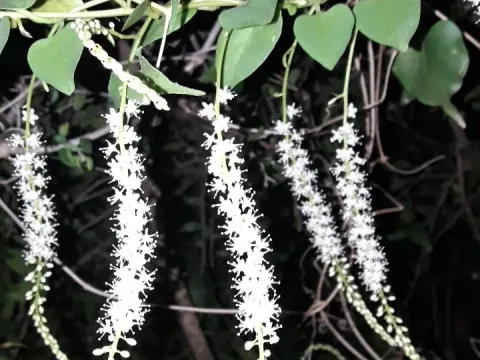
Anredera
Anredera Juss.
Anredera, commonly referred to as the Madeira-vine, belongs to the Basellaceae family. It is a vigorous perennial tropical climber that is frequently grown as an annual in temperate climates due to its lack of cold tolerance.
What the section contains

Anredera
Propagation is primarily achieved through vegetative means, specifically using aerial tubers that form in the leaf axils, or by dividing the rhizomes. Planting in open ground should occur only after the danger of frost has passed and the soil has reached 15-18 degrees Celsius.
Tubers should be planted at a depth of 3–5 cm in loose, well-draining soil. Providing a trellis or support system is essential, as the plant exhibits aggressive growth and requires sufficient vertical space to thrive.
For an earlier start to the growing season, tubers can be pre-sprouted indoors in late March. This practice ensures that the plants are well-established by the time they are moved outside, significantly increasing the potential harvest.
Sexual propagation via seeds is rarely practiced in commercial agriculture due to the unpredictability of germination, making vegetative multiplication the standard approach for maintaining crop consistency.
Anredera requires a bright, indirect light environment for optimal photosynthesis. While it thrives in sunshine, it is advisable to provide partial shade during the hottest afternoon hours to prevent leaf scorching.
The plant performs best in neutral to slightly acidic, fertile, and well-drained soil. Waterlogging is detrimental to the plant, as it rapidly promotes root rot and degrades the quality of the underground tubers.
Temperature management is critical for success. The plant prefers a range between 20 and 28 degrees Celsius. When temperatures drop below 10 degrees, the metabolism of the plant slows, necessitating a transition to protected environments.
Consistent, moderate moisture is key to the health of the plant. The soil should remain damp but never waterlogged. Regular misting of the leaves in drier environments can improve the overall turgor and vitality of the vine.
During the peak growing season, the application of balanced nitrogen-rich fertilizers is beneficial. However, fertilizing should be discontinued as autumn approaches to allow the plant to naturally transition into dormancy.
The economic value of Anredera lies in its edible leaves and nutrient-dense tubers. Leaf yield is largely dependent on the frequency of harvest and the availability of essential nutrients, while tuber yield is determined by the length of the growing season.
Given its high growth rate, the plant can produce a substantial amount of biomass within a single season. Proper support systems not only maximize yield but also improve the quality of the harvested produce by ensuring better air circulation.
Vertical cultivation is the most effective method for maximizing land use efficiency. By keeping the foliage off the ground, the risk of fungal infection is reduced, and the energy of the plant is redirected toward tuber development.
Harvesting the tubers is typically performed at the end of the season when the foliage dies back. This timing ensures that the tubers have reached peak maturity and are filled with stored nutrients.
Proper post-harvest management is essential. Tubers should be carefully cleaned and dried to prevent decay, ensuring they remain viable for consumption or as planting stock for the following year.
Common pests affecting Anredera include spider mites and aphids, which are particularly prevalent in greenhouse environments or during periods of low humidity. These pests can rapidly colonize the foliage if left unchecked.
Root and tuber rot represent the most significant threat to the crop. This condition is almost exclusively associated with over-irrigation and poor soil drainage, which creates an anaerobic environment hostile to the plant.
Fungal leaf spot diseases may appear when ventilation is inadequate. These spots can lead to premature leaf senescence, ultimately reducing the photosynthetic capacity of the plant and its overall yield.
Preventative measures, such as maintaining good spacing between plants and ensuring optimal ventilation, are the most effective strategies. If necessary, biological insecticides can be used to manage pest populations.
- Sanitize all gardening tools between uses.
- Monitor the undersides of leaves for early signs of pests.
- Ensure soil pH remains within the recommended range.
Leaf harvesting can be conducted gradually throughout the summer. It is best to remove only mature leaves, ensuring that the plant retains enough foliage to continue photosynthesizing and supporting the growth of the tubers.
The main tuber harvest occurs after the first signs of senescence in the autumn, signaled by the yellowing of the vines. At this point, the plant naturally directs all energy to the underground storage organs.
When digging up the tubers, care should be taken to use tools that minimize damage. Bruised or cut tubers are highly susceptible to infection and should be separated for immediate use rather than storage.
Post-harvest, the tubers require a drying period of 2-3 days in a dark, airy place. This step allows the skin to harden, which is crucial for protecting the internal tissue during long-term storage.
For storage, the tubers should be kept in a cool, dry area at approximately 5-8 degrees Celsius. Storing them in a box with dry sand or peat moss helps regulate humidity and prevents the tubers from dehydrating.