
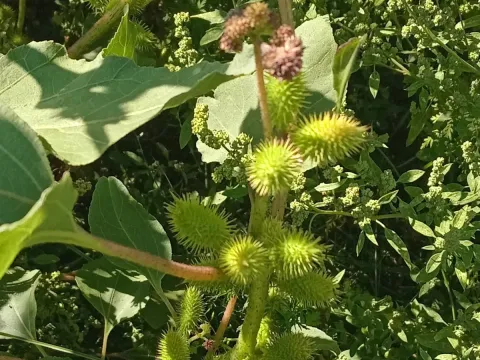
Siberian cocklebur
Xanthium sibiricum
Siberian cocklebur (Xanthium sibiricum) belongs to the Asteraceae family. It is an annual herbaceous plant widely recognized for its high content of biologically active compounds used in traditional and modern medicine.
What the section contains
Siberian cocklebur
Sowing typically occurs in early spring once the soil temperature consistently reaches 10 degrees Celsius. Due to the hard seed coat, pre-sowing treatments like scarification or stratification are recommended to improve germination rates.
The optimal planting density is essential for yield. Seeds should be placed at a depth of 3 to 5 centimeters, with rows spaced 45–60 centimeters apart to ensure proper air circulation and sunlight penetration.
During the germination phase, consistent soil moisture is crucial. Seedlings usually emerge within two weeks, provided the soil remains moist and temperatures stay above the minimum threshold.
Proper field planning includes weed management, as young cocklebur plants are initially slow to grow and can be easily outcompeted by aggressive weeds in the early stages of development.
This plant thrives in full sun conditions. Light intensity is a primary driver for the synthesis of secondary metabolites, making sunny, open locations the ideal choice for its cultivation.
Regarding soil preferences, Siberian cocklebur is relatively adaptable but achieves the best results in loose, fertile loamy soils or rich chernozems that provide excellent drainage.
Although it has a strong, deep taproot system that provides drought resistance, supplemental irrigation during peak summer growth stages is beneficial for maximizing total biomass production.
The plant performs best in neutral pH soils. If the soil is acidic, liming should be performed before planting to create an environment that encourages optimal nutrient uptake and robust growth.
Regular maintenance, including shallow cultivation between rows, helps conserve soil moisture and suppresses weed competition, ensuring the plants reach their full yield potential by harvest time.
Siberian cocklebur is susceptible to powdery mildew, especially in regions with high humidity or poor air circulation within the canopy, which can lower the quality of the harvested aerial parts.
Insect pests such as leaf-eating beetles and moth larvae pose a significant threat, particularly in the seedling stage. Heavy infestations can retard plant growth and reduce overall yields.
Disease management relies on preventive strategies, including crop rotation and the prompt removal of crop debris after harvest to prevent the build-up of pathogens in the soil for the next season.
While chemical pesticides are an option, they must be used sparingly to meet organic or medical-grade standards, prioritizing biological controls that effectively manage pest populations without harming the environment.
Scouting the fields regularly allows for the early detection of localized outbreaks, enabling farmers to intervene with targeted measures rather than broad-spectrum applications that might disrupt the ecosystem.
The harvest period is critical for maximizing medicinal value. The crop should be collected during the active flowering phase when the concentration of key pharmacologically active compounds is at its peak.
Harvesting is performed by mowing the plant approximately 10–15 centimeters above the soil line. It is essential to work during dry conditions to prevent spoilage and ensure the quality of the final product.
Freshly harvested plant material is prone to rapid moisture accumulation and self-heating. Immediate processing and transportation to the drying facility are mandatory to avoid molding and degradation.
Drying should take place in well-ventilated areas or specialized dryers where the temperature is carefully monitored and kept below 45 degrees Celsius to preserve volatile organic compounds.
Once dried to the required moisture level, the product should be cleaned, sorted for impurities, and stored in protected, moisture-proof conditions to maintain its shelf life and chemical stability for distribution.