
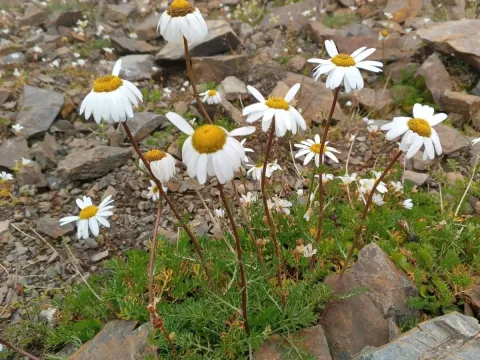
Caucasian mayweed
Tripleurospermum caucasicum
Caucasian mayweed (Tripleurospermum caucasicum) is a herbaceous plant belonging to the Asteraceae family. In an agricultural context, it is widely recognized as a problematic weed that interferes with the productivity of various crops by competing for essential resources.
What the section contains
Caucasian mayweed
The plant exhibits a branched stem structure and deeply dissected, feathery leaves. Its deep taproot system provides significant drought resistance, making it a robust competitor against shallow-rooted agricultural crops during the early stages of growth.
The native range centers on the Caucasus region, yet the species has shown great adaptability to various environmental conditions. It thrives in open, sunny environments and is frequently found in disturbed soils, along field edges, and within unmanaged crop areas.
It prefers well-drained, nutrient-rich soils but can establish itself in a variety of substrates. Soil moisture levels are the most critical factor for seed germination, with spring conditions being optimal for the emergence of new seedlings.
Agricultural management is essential because the species is a prolific seed producer. A single plant can release thousands of seeds into the soil bank, necessitating long-term control strategies to reduce the seed density over subsequent growing seasons.
The primary threat posed by this weed is the rapid depletion of soil moisture and nutrients, which significantly reduces the yield of nearby cash crops. This competition is most intense during the vegetative phase of development.
Caucasian mayweed acts as a host for various pathogens, including powdery mildew and rust, which can subsequently infect neighboring wheat or barley crops. This makes the weed a significant factor in integrated pest management programs.
Insects such as aphids and specialized coleopterans frequently utilize the foliage of the mayweed. Managing these populations requires monitoring the weed density, as these pests can migrate to cultivated crops once the weed population declines or is controlled.
Chemical control involving selective herbicides is often required, but effectiveness varies depending on the plant's growth stage. Early application before the flowering stage is crucial to prevent further seed dispersal.
Mechanical cultivation remains a standard preventative measure. Regular hoeing or harrowing disrupts the root system and prevents the weed from establishing a dominance in row-cropped fields, ensuring better aeration and crop health.