
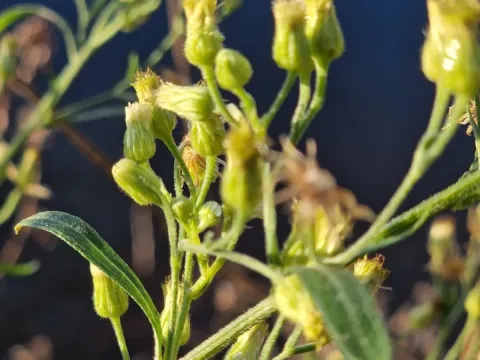
Sumatran fleabane
Erigeron sumatrensis
Sumatran fleabane (Erigeron sumatrensis) is an annual herbaceous weed belonging to the Asteraceae family. It is recognized as a significant invasive plant species that thrives in agricultural fields, pastures, and disturbed land across many countries.
What the section contains
Sumatran fleabane
The plant exhibits high ecological flexibility, allowing it to adapt to various soil conditions, including poor or compacted soil. It prefers open, sunlit areas with moderate moisture, but it is capable of surviving in diverse climatic zones, ranging from tropical to temperate.
Originally native to South America, it has spread globally due to the efficient wind dispersal of its seeds. Its rapid expansion has made it a problematic species in modern agriculture, often colonizing crops before they reach canopy closure.
Botanically, it is identified by its upright, branched stem, which can grow up to 2 meters high, and its characteristic dense pubescence. The leaves are lanceolate, and the flowers are organized into numerous small flower heads forming a panicle-like inflorescence.
In terms of agricultural use and impact, it is considered a major weed that competes aggressively for resources. Left unchecked, Sumatran fleabane can significantly reduce crop yields by depriving seedlings of light, water, and essential soil nutrients.
The primary threat posed by this species is the widespread development of resistance to glyphosate and other common herbicides. Effective management now requires a strictly integrated approach, including the rotation of herbicide modes of action and mechanical tilling.
While the plant is susceptible to some fungal pathogens and occasional insect pests such as aphids, these natural enemies are insufficient for population suppression. Integrated Pest Management (IPM) is essential to mitigate the economic damage caused by this resilient weed.