
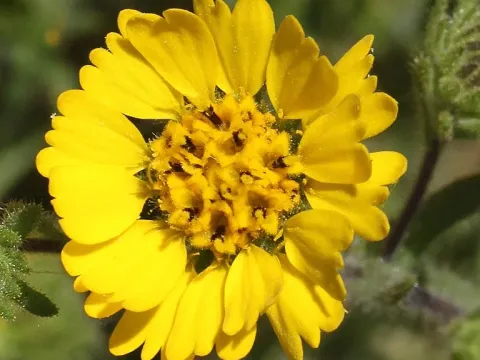
Deinandra
Deinandra
Deinandra seeds are typically sown in spring once the soil temperature consistently reaches 10–12 degrees Celsius. Ensuring the absence of late frost is crucial for successful establishment and uniform germination.
What the section contains


Deinandra
The optimal seeding depth ranges from 1 to 2 centimeters due to the small size of the seeds. Mechanical drilling is the most common practice, ensuring consistent spacing between rows for easier maintenance.
The timing of planting should consider the length of the growing season and day length, as the crop is sensitive to photoperiodic changes during early vegetative growth stages.
Preparing a fine seedbed is essential to provide good soil-to-seed contact. Proper field leveling helps in maintaining uniform depth and prevents uneven emergence across the planted area.
Sowing density should be managed according to local environmental conditions. Excessive density may lead to competition for nutrients and water, potentially reducing the overall yield per plant.
Deinandra, a member of the Asteraceae family, is native to the arid regions of California. It is highly adapted to hot, dry summers and can withstand significant heat stress without wilting.
The plant thrives in well-drained, sandy, or light-textured soils. It is highly intolerant of waterlogged conditions, making well-drained slopes or sites with excellent drainage essential for success.
While Deinandra is drought-tolerant, supplemental irrigation during the critical flowering stage can significantly improve seed set and total yield. Its deep root system allows it to tap into deeper soil moisture.
It prefers neutral to slightly alkaline soil pH and does not require heavy fertilization. Moderate application of nitrogen-based fertilizers can boost growth, but over-fertilization should be avoided.
The crop requires full sun exposure throughout the day. Shading, even from neighboring weeds or tall crops, significantly impairs growth, flowering, and seed maturation.
The yield potential of Deinandra varies depending on agricultural practices and seasonal weather conditions. Achieving high yields requires careful attention to crop management, especially during the seed development phase.
Modern breeding focuses on increasing oil content and ensuring synchronized seed maturation. These factors are critical for determining the economic viability of the crop in large-scale production.
Seed quality and oil composition depend heavily on the availability of essential nutrients during the formation of reproductive structures. A balanced nutrient program ensures high-quality end products.
The adoption of precision farming techniques can help mitigate environmental risks and optimize input efficiency. Consistent care throughout the growing cycle is key to realizing the crop's maximum potential.
Economic assessments weigh total seed mass against the percentage of extractable oil. Improving these traits continues to be a priority for researchers working with this unique oilseed species.
Deinandra is susceptible to common Asteraceae pathogens, including powdery mildew. High humidity and poor airflow around the foliage are primary factors that exacerbate disease outbreaks.
Pests such as aphids and spider mites can cause significant damage by feeding on plant sap. These insects can reduce the vigor of the crop and provide entry points for secondary infections.
Root rot, driven by poor soil drainage and waterlogging, is a major threat. Preventive measures, such as proper site selection and crop rotation, are more effective than curative treatments.
Integrated Pest Management (IPM) strategies, which prioritize biological control and early detection, are highly effective in maintaining healthy crops in arid environments.
Weed management during the early growth phase is vital. Because Deinandra grows relatively slowly initially, it can easily be outcompeted by aggressive weeds if not properly controlled.
Harvesting should be timed to match the physiological maturity of the seeds. Waiting until the seeds are fully dry in the head is necessary, but delayed harvest increases the risk of seed shattering.
Signs of readiness include a color change of the stem and leaves to a golden brown or straw-like appearance. At this stage, the seeds are firm and ready for mechanical processing.
Direct combining is the preferred method of harvesting, although it requires careful adjustment of cylinder speed and concave clearance. Minimizing mechanical damage to seeds is essential for quality.
Swathing or windrowing may be practiced in areas with unpredictable late-season weather. This technique allows for uniform drying and can help preserve seed quality before final collection.
Post-harvest handling involves thorough cleaning and drying to moisture levels that prevent fungal growth and lipid degradation during storage. Proper storage conditions ensure long-term viability.