
Deinandra floribunda
Deinandra floribunda
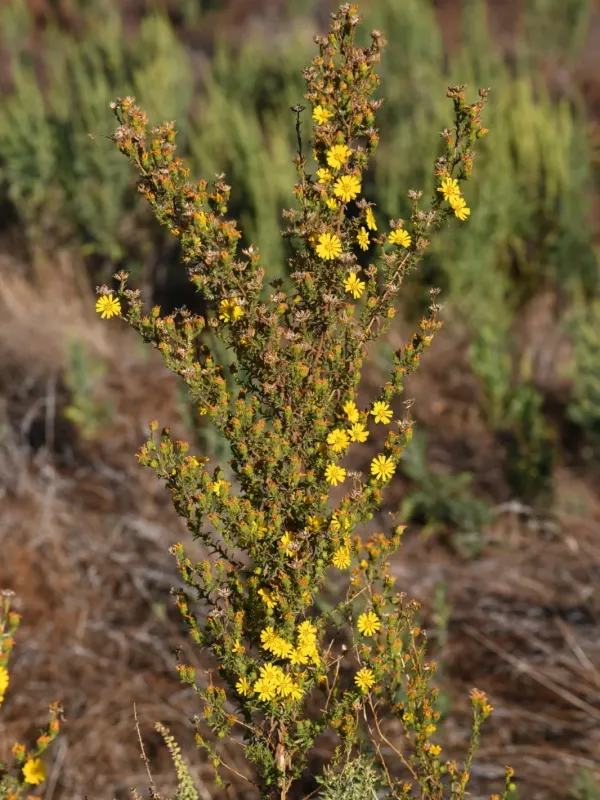
Description
Growing requirements
Deinandra floribunda, commonly known as a member of the Asteraceae family, is an annual herbaceous plant native to arid and semi-arid regions of North America. Its resilience makes it a subject of interest for sustainable agriculture in hot, dry environments.
The crop thrives in well-drained soils and requires full sun exposure to reach its maximum productivity. Unlike many traditional crops, it can tolerate low-fertility soils, provided that the soil structure allows for deep root penetration and avoids waterlogging.
Climate requirements for this species include high temperatures during the flowering stage and a lack of excessive humidity. It is uniquely adapted to thrive in areas where water availability is limited, making it a potentially viable alternative for drought-prone regions.
Cultivation practices focus on preparing a firm, weed-free seedbed to ensure uniform germination. Row spacing should be optimized based on local moisture availability to prevent excessive competition between plants for limited soil nutrients.
Proper soil aeration is essential for the development of its taproot system. Farmers should avoid deep plowing that destroys the soil structure, preferring minimal or no-till practices to preserve the soil moisture that is crucial during the early stages of growth.
Harvesting
Harvesting Deinandra floribunda occurs when the seed heads are fully mature and show signs of drying. Monitoring the color of the heads is critical, as they turn from green to a deep brown when the seeds are ready for collection.
The use of combine harvesters requires precise calibration of the headers and the threshing cylinder speed to prevent seed shattering. Because the seeds are often small and delicate, minimizing mechanical stress is vital for maintaining seed quality.
Cleaning the seed lot immediately after harvest is a standard procedure to remove husks and plant debris. This prevents the heating of the stored material and protects the seeds from potential fungal infections caused by trapped moisture.
Drying the harvested seeds should be done in a shaded, well-ventilated facility. Controlled airflow prevents the oxidative degradation of the oils contained within the seeds, which is necessary to ensure the high commercial value of the final product.
Long-term storage requires cool and dry conditions. By keeping the moisture content stable, growers can maintain high germination rates and oil stability for subsequent industrial processing or planting in the next season.