
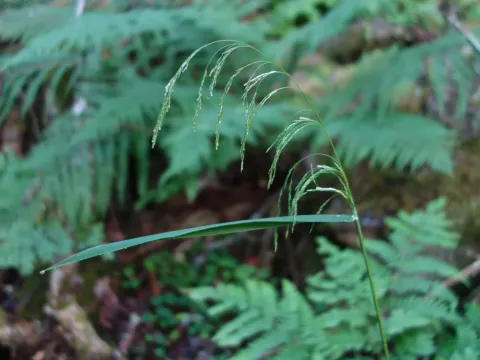
Drooping woodreed
Cinna latifolia
Drooping woodreed (Cinna latifolia) is a perennial grass species belonging to the Poaceae family. It is typically found in cool, moist forest environments, demonstrating a preference for partial shade and high soil moisture levels throughout the growing season.
What the section contains
Drooping woodreed
The plant is highly cold-hardy, thriving in northern temperate regions across North America and Eurasia. Its ability to tolerate low-light conditions makes it a unique candidate for understory forage and land rehabilitation in shaded areas where traditional pasture grasses struggle.
Regarding soil requirements, Cinna latifolia prefers fertile, loam-based soils with good water-holding capacity. It performs well in neutral to slightly acidic pH levels, reflecting its natural forest floor habitat where organic matter is readily available.
Agrotechnical management focuses on maintaining consistent soil moisture. Unlike sun-loving crops, this species does not require full solar exposure, which simplifies site selection in areas characterized by canopy cover or forest edges.
Economically, drooping woodreed serves as a forage resource for livestock and wildlife. Its palatable foliage and ability to resprout after grazing contribute to its potential as a supplementary grass in managed forestry-pasture systems.
Like many cool-season grasses, drooping woodreed is susceptible to fungal pathogens such as rusts and various leaf spots if humidity levels remain excessively high for extended periods. These diseases can reduce biomass production if left unchecked.
Insect pests are generally a minor concern for this species, but stem-boring insects may occasionally cause damage in dense, poorly managed stands. Monitoring during the peak vegetative stage is recommended to prevent significant impact on seed yields.
Management strategies emphasize cultural controls over chemical interventions. Providing adequate airflow through proper spacing helps mitigate the risk of fungal outbreaks, while maintaining balanced soil nutrients strengthens the plant's natural defenses.
Weed pressure can be a significant threat during the establishment phase. Ensuring that the site is cleared of aggressive competitive species before sowing is essential for the long-term success of the stand.
Integrated pest management (IPM) for this crop involves periodic scouting for chlorotic spots or wilting symptoms. Early detection allows for targeted maintenance that preserves both the nutritional quality of the forage and the plant's overall vigor.