
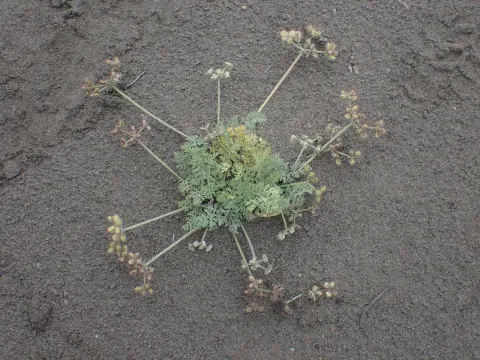
Dune Carrot
Pseudorlaya pumila
Dune Carrot (Latin: Pseudorlaya pumila) is an annual herbaceous plant belonging to the Apiaceae family. It is a highly specialized plant that thrives in sandy coastal environments, showing exceptional tolerance to salt spray and arid conditions.
What the section contains
Dune Carrot
The plant is native to the Mediterranean region, where it naturally populates sandy dunes and maritime habitats. Its evolutionary adaptations allow it to prosper in environments that are largely hostile to most conventional agricultural crops.
Botanically, Pseudorlaya pumila features a low-growing rosette form and glandular hairs that reduce transpiration. These features are critical for moisture retention in the harsh, high-heat environments typical of its native range.
The optimal soil requirements for this crop are well-drained, porous, and sandy textures. It requires high sunlight exposure and cannot survive in waterlogged or heavy clay soils, which promote fungal decay.
In terms of usage, the Dune Carrot is primarily utilized in ecological engineering for dune stabilization and coastal restoration projects, preventing soil erosion in sensitive seaside landscapes.
The primary threats to Pseudorlaya pumila are fungal pathogens, specifically those causing root rot and damping-off, which typically occur when soil humidity levels are excessively high.
Insect pests, including aphids and various mites, pose a significant risk to plant vigor. These pests target the younger foliage, potentially leading to stunted growth if left unmanaged in a controlled environment.
Competition from invasive plant species is a major threat. As a low-growing species, the Dune Carrot requires regular weeding to ensure it receives adequate sunlight and nutrient access throughout its growing cycle.
Soil-borne nematodes can cause localized damage to the root system, which significantly affects the plant's ability to extract nutrients from poor sandy substrates, eventually compromising the entire crop.
Climate instability, particularly untimely heavy rainfall during the seed germination phase, represents a significant risk factor that can lead to large-scale losses in field conditions.