
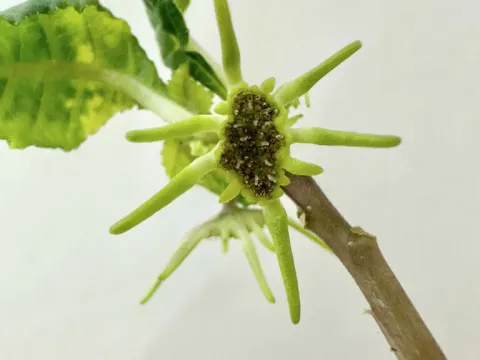
Dorstenia mannii
Dorstenia mannii
Dorstenia mannii is an intriguing tropical plant belonging to the Moraceae family. It is distinct for its succulent nature, which allows it to thrive in specific ecological niches within the rainforests of Central and West Africa.
What the section contains
Dorstenia mannii
In its native environment, the plant grows as an understory species, adapted to dappled sunlight and consistently high humidity. It often colonizes rocky outcrops or organic-rich debris, making it a specialized plant that requires careful placement in cultivation.
Optimal growth requires a stable environment with temperatures between 20°C and 28°C. Cold drafts and significant temperature fluctuations can cause leaf drop and stunt growth, making indoor climate control essential in non-tropical regions.
The growing medium must be highly porous and well-draining to mimic the plant's natural habitat. A mixture of peat, coarse sand, and perlite is ideal, ensuring that the roots remain aerated while retaining sufficient moisture for the plant's needs.
Watering should be approached with caution, following a cycle of thorough wetting and allowing the substrate to dry out partially. Overwatering is the most common cause of failure, as it easily leads to caudex rot and rapid decline of the root system.
Mealybugs are the primary pest concern for Dorstenia mannii. These insects tend to cluster in the leaf axils, and their presence can quickly weaken the plant. Regular inspection is necessary to catch infestations before they spread significantly.
Spider mites frequently target this species when ambient humidity is too low. Increasing air moisture and maintaining proper airflow can help prevent these pests from establishing populations that damage the foliage.
Root rot is a major threat linked to poor agricultural practices, specifically over-watering or using soil that retains too much moisture. Once rot sets in, saving the plant is difficult, necessitating immediate removal of affected tissue and repotting.
Fungal leaf spots can occur when air circulation is inadequate, leading to persistent moisture on the leaves. Providing gentle ventilation helps keep the foliage dry and prevents the proliferation of harmful spores in the microclimate.
Overall plant health is closely tied to light management. While the plant prefers shade, insufficient light will cause spindly growth, making the plant more susceptible to diseases and structural failure, whereas direct, harsh sun will scorch the leaves.