
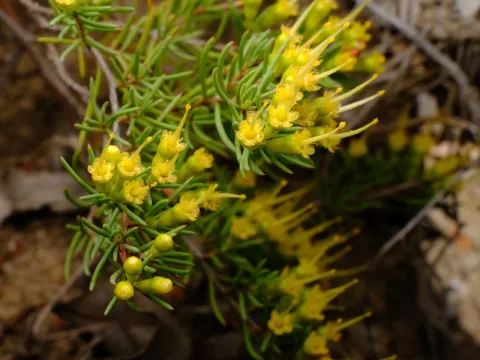
Homoranthus
Homoranthus
Homoranthus is a genus of evergreen shrubs belonging to the Myrtaceae family. Native to Australia, these plants are well-adapted to harsh environments, often thriving in rocky, sandy, and well-drained soils found in various bushland habitats.
What the section contains
 Homoranthus croftianus
Homoranthus croftianus
Homoranthus croftianus
 Homoranthus flavescens
Homoranthus flavescens
Homoranthus flavescens
 Homoranthus lunatus
Homoranthus lunatus
Homoranthus lunatus
 Homoranthus melanostictus
Homoranthus melanostictus
Homoranthus melanostictus
 Homoranthus montanus
Homoranthus montanus
Homoranthus montanus
 Homoranthus papillatus
Homoranthus papillatus
Homoranthus papillatus
 Homoranthus prolixus
Homoranthus prolixus
Homoranthus prolixus
 Homoranthus virgatus
Homoranthus virgatus
Homoranthus virgatus
Homoranthus
When cultivating Homoranthus, providing a site with excellent drainage is the most critical requirement. The root system is highly sensitive to waterlogging, making raised beds or slopes the preferred locations for planting these specimens to ensure aeration.
The plant requires full sun exposure to reach its maximum ornamental potential. While some species show resilience to light frost, they generally thrive in warm, temperate climates that mimic their native Australian conditions, emphasizing stability in temperature and moisture levels.
Botanically, Homoranthus is characterized by its small, opposite leaves often rich in essential oils and distinctive, showy flowers with prominent stamens. This structure makes the genus a favorite for xeriscaping and sustainable garden designs.
The primary economic and horticultural use of the crop is ornamental. It is valued by landscaping professionals for its structural interest and ability to contribute to low-maintenance, drought-tolerant garden schemes.
The most significant threat to Homoranthus is the fungal disease caused by Phytophthora species, which target the roots under conditions of poor drainage or high soil moisture. This pathogen can lead to rapid decline and death of the plant.
Insect pests, such as scale insects and spider mites, may periodically infest the foliage, particularly if the plant is under environmental stress. Monitoring for these pests is essential, especially during dry and warm seasons when spider mites are most active.
To prevent disease outbreaks, cultivators should avoid overhead irrigation and ensure proper spacing between plants. Maintaining good air circulation is a standard cultural practice to mitigate humidity-related issues in the canopy.
Regular sanitation, which includes removing dead or dying branches, helps in reducing potential sites for pathogen development. If infestations occur, using horticultural oils or targeted biological control methods is recommended over harsh chemical sprays.
Effective management relies on proactive observation. Early detection of leaf yellowing or stunted growth can signal underlying issues that require immediate adjustments to irrigation or environmental control measures.