
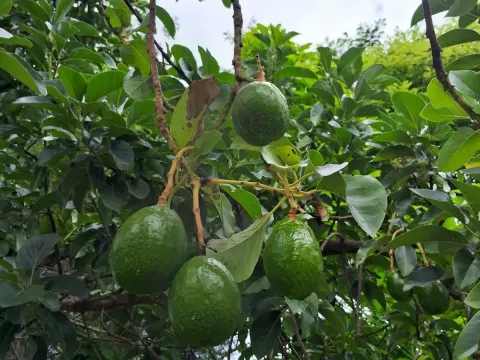
Avocado
Persea
Avocado (Persea americana) is a member of the Lauraceae family. As a subtropical evergreen tree, its agricultural production relies predominantly on grafting scions onto selected rootstocks to maintain consistent varietal characteristics and ensure disease resistance.
What the section contains


Avocado
Seed-based propagation is generally avoided in commercial farming due to genetic variability and long juvenile periods. Instead, nurseries select specific rootstock cultivars that show immunity or tolerance to soil-borne pathogens like Phytophthora, which is essential for orchard longevity.
Planting is typically carried out during the onset of the rainy season to allow root establishment before peak temperatures occur. Optimal spacing ranges from 200 to 400 trees per hectare, depending on the cultivar’s growth habit and the chosen pruning system.
Soil preparation is critical; avocado trees require extremely well-drained soil. They are highly susceptible to root rot in saturated or heavy clay environments, making raised beds or drainage infrastructure mandatory in many production regions.
Young trees require protection from direct sunlight and wind in the initial years. Growers often use whitewash on trunks to prevent sunburn and apply organic mulch to maintain soil moisture and stabilize the root zone temperature.
Avocado trees are sensitive to extreme weather. Most commercial varieties thrive in warm, frost-free climates. Even mild frosts can cause significant damage to foliage and fruit, potentially destroying an entire season's production.
Consistent water availability is necessary, yet the trees have a very low tolerance for waterlogging. Precision irrigation systems, such as drip irrigation, are standard in modern orchards to ensure that moisture reaches the roots without causing anaerobic conditions.
Protection from high winds is vital, as the tree’s branches are brittle and susceptible to breakage. Windbreaks, composed of fast-growing hedges or trees, are essential to minimize mechanical damage and prevent excessive fruit drop during development.
The trees require a soil pH range of 5.5 to 7.0 and are particularly sensitive to micronutrient deficiencies. Iron and zinc levels must be monitored closely, as deficiencies often lead to chlorosis, which reduces the tree's photosynthetic capability.
Adequate sunlight is required for uniform flowering and fruit set. Proper canopy management through pruning ensures that light penetrates the center of the tree, which is necessary for maintaining productivity and health throughout the inner branches.
Yield varies significantly based on tree age, soil health, and varietal selection. Most grafted trees reach commercial productivity within 4 to 5 years, with full yield potential being achieved between 10 and 20 years of age.
Average yields for established orchards range from 10 to 20 metric tons per hectare. High-density, well-managed farms may exceed these figures, provided that pollination and nutrient requirements are fully met during the flowering season.
Many commercial cultivars exhibit biennial bearing, where a high-yield year is followed by a lower-yield one. Integrated management strategies, including specific pruning techniques and balanced fertilization, are employed to minimize this cycle.
Canopy architecture plays a key role in yield. Pruning serves a dual purpose: it controls the tree height for easier harvest while promoting the development of fruit-bearing wood throughout the entire profile of the canopy.
The economic value of avocado production is bolstered by the fruit’s versatility. Beyond the fresh market, the industry processes significant volumes of fruit into high-quality oils and specialty ingredients for the food and cosmetics sectors.
Root rot, caused by the oomycete Phytophthora cinnamomi, is the single most destructive disease in avocado farming worldwide. It thrives in wet, poorly drained soils, making it almost impossible to eradicate once an orchard is infested.
Pests like thrips and spider mites are constant threats. They feed on foliage and young fruit, causing scarring and reduced photosynthetic efficiency. Integrated Pest Management (IPM) is the preferred approach, combining biological controls with targeted chemical interventions.
Anthracnose is a frequent post-harvest disease, manifesting as dark, sunken lesions on the skin and flesh. It is most prevalent in humid conditions and can be mitigated by proper orchard sanitation and post-harvest fungicide treatments.
- Root rot (Phytophthora)
- Spider mites
- Thrips
- Anthracnose
To keep orchards healthy, growers follow strict sanitary protocols: removing fallen leaves to prevent fungal spores from spreading, maintaining tree vigor through balanced nutrition, and regularly inspecting for early signs of infection.
Harvesting avocado is a precise operation. Because the fruit does not ripen on the tree, it must be harvested at the correct physiological maturity to ensure it will ripen properly after being picked.
Growers use oil content analysis to determine the optimal harvest window. As the fruit matures, its oil percentage increases. Once the specific threshold for a cultivar is reached, the fruit is considered ready for commercial harvest.
Harvesting is primarily manual, using specialized clippers. The fruit is cut with a small portion of the stem attached to prevent pathogens from entering the fruit, which is a major factor in minimizing post-harvest losses.
Sorting and grading take place immediately after harvest. Any fruit with physical damage, skin punctures, or signs of disease must be culled, as a single rotten avocado can rapidly spread decay to the entire shipping container.
Cold chain management is non-negotiable. After harvest, avocados should be cooled to a specific temperature to slow down metabolic activity. Maintaining this temperature through to the final destination is key to delivering high-quality fruit to consumers.