
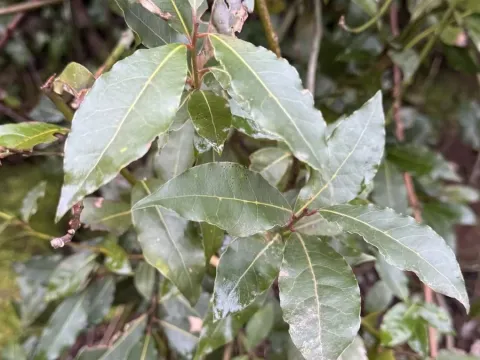
Bay laurel
Laurus L.
Propagation of bay laurel (Laurus nobilis) is mainly carried out by seeds or vegetatively through cuttings. Seeds should be sown immediately after harvest, as they quickly lose viability, typically in February or March in a protected environment.
What the section contains

Bay laurel
Cutting propagation is considered more effective for maintaining varietal characteristics. Young shoots are cut in spring or early summer and planted in a substrate of sand and peat under high humidity conditions.
It is essential to ensure a stable temperature of around 20–22 degrees Celsius for successful rooting. During the first years of growth, seedlings develop slowly and require careful attention to watering and light levels.
When transplanting into open ground in temperate climates, seedlings should be 2–3 years old. For commercial cultivation, planting density must be optimized to facilitate mechanical maintenance and harvesting.
As an evergreen plant of the Lauraceae family, bay laurel is highly sensitive to abrupt temperature shifts during its early growth stages.
Bay laurel is a heat-loving crop native to the Mediterranean region, requiring abundant sunlight to effectively produce essential oils in its leaves. The plant prefers well-drained, fertile loamy soils with a neutral or slightly acidic reaction.
The crop does not tolerate waterlogging, so areas with high groundwater levels require effective drainage systems. During the active growing season, laurel needs regular watering, which should be significantly reduced during winter.
The optimal temperature for growth ranges from 15 to 25 degrees Celsius. While mature plants can withstand brief frosts down to minus 10–12 degrees, prolonged cold periods can be fatal to the aerial parts of the plant.
In indoor conditions, bay laurel requires good ventilation and regular leaf misting, as dry air often causes leaf curling. For container-grown plants, repotting should be performed every 2–3 years as the root system expands.
Fertilization with balanced mineral fertilizers from spring to late summer stimulates vigorous vegetative growth, improving the overall quality of the foliage.
The economic value of bay laurel lies in its leaves, which are used as a spice and as raw material for essential oil production. Commercial exploitation of plantations usually begins 4–5 years after establishment, once the canopy reaches sufficient volume.
Yields depend on the age of the tree, planting density, and overall agrotechnical management. With proper canopy pruning, one hectare can produce several tons of dried commercial leaf annually.
Harvesting is performed selectively by cutting shoots with leaves, or via total canopy pruning, depending on the management technology. Leaves are then dried in well-ventilated areas shielded from direct sunlight.
Product quality is determined by essential oil content, which should normally be at least 2–3% of the dry leaf mass. Storage requires airtight packaging to prevent the loss of volatile aromatic compounds.
Bay laurel is also extensively used in landscape design, where its ornamental features are often prioritized over its culinary harvest yield.
The primary pests affecting this crop are scale insects and soft scales, which infest leaves and young shoots, extracting sap and weakening the plant. Spider mites are also common, thriving in low-humidity conditions.
Among fungal diseases, sooty mold poses the greatest risk, developing on the sticky secretions left by sucking insects. This leads to aesthetic degradation and impaired photosynthesis.
Bacterial infections can attack the root system if the soil remains chronically waterlogged, causing rot and potential seedling death. Preventive measures include regular plant inspection and the removal of affected parts.
Pest management involves using broad-spectrum insecticides or biological controls, ensuring compliance with pre-harvest intervals. Maintaining optimal microclimate balance significantly reduces the risk of epiphytotics.
- Scale insects and soft scales
- Spider mites
- Sooty mold
- Root rot
Harvesting bay laurel is a labor-intensive process requiring careful handling of the foliage. Harvesting should take place during dry weather to prevent raw material spoilage during storage.
For commercial use, the most valuable leaves are those harvested from two- to three-year-old branches, as these contain the highest concentration of aromatic compounds.
After cutting, the shoots are bundled or spread in thin layers on drying racks. Drying must occur slowly in the shade to allow the leaves to retain their natural olive-green color.
Mechanical harvesting is possible using specialized combines that prune bushes at a predetermined height. Subsequent sorting allows the product to be categorized by size and quality.
Properly dried bay laurel possesses a distinct spicy aroma and a bitter-astringent taste, retaining its culinary properties for 1–2 years when stored under appropriate conditions.