
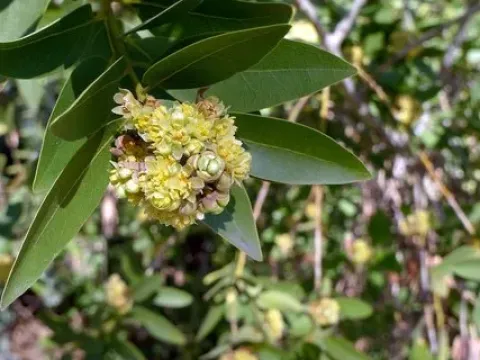
California bay
Umbellularia
Propagation of the California bay (Umbellularia californica) is primarily achieved through seed germination. Seeds should be collected when fully ripe and require a period of cold stratification to overcome dormancy before sowing.
What the section contains

California bay
For best results, seeds are sown in autumn into a well-draining, moist potting mix. Keeping the seedbed in a shaded, cool area during winter mimics the natural environment and improves the success rate of germination in the following spring.
Vegetative propagation via cuttings is also possible, though more technically demanding. Semi-hardwood cuttings taken in late summer should be treated with rooting hormone and placed in a misting propagation unit.
Seedlings are best planted in their permanent locations when they reach 12–18 months of age. Careful handling of the root ball is essential to prevent transplant shock, which can stunt the growth of young trees.
Young plants require consistent monitoring of soil moisture during the first year of establishment, as they are vulnerable to extreme drying during their early development stages.
This species belongs to the Lauraceae family and is native to the coastal regions of western North America. It thrives in a Mediterranean-type climate characterized by wet winters and dry, warm summers.
The California bay requires deep, fertile, and well-drained soils to prevent root rot, which is a major physiological challenge. It is highly intolerant of waterlogged conditions and poorly aerated substrate.
While the tree is moderately frost-hardy, extreme temperature drops can cause significant branch dieback. In cooler climates, it is often kept as a container plant and moved indoors during the winter months.
Regarding light, it is adaptable, growing well in full sun to partial shade. However, optimal growth and oil content in the leaves are typically achieved with moderate exposure to sunlight throughout the day.
Established trees are quite drought-tolerant, but supplementary watering during extended dry periods significantly improves foliage quality, which is crucial for those cultivating the tree for its aromatic leaves.
The primary economic output is the foliage, which is harvested for its potent aromatic oils. These leaves are used as a culinary spice, often considered a stronger, more pungent alternative to traditional bay leaves.
Harvesting is typically done manually, focusing on healthy, mature leaves. Selective pruning helps maintain the tree's health while providing a steady supply of leaves throughout the growing season.
The wood of the California bay, locally known as "Oregon myrtle," is a high-value commodity. It is prized for its dense grain, rich colors, and unique patterns, making it ideal for fine woodworking and lathe turning.
The tree also produces fruit, which, while not a primary crop, has historical and industrial potential due to the presence of fatty oils. Proper management of the tree density is required to maximize both foliage and timber yields.
Sustainability in production is achieved by balancing the harvest cycles with the natural growth rate of the species, ensuring the tree remains productive for many decades.
The most significant threat to Umbellularia californica is Sudden Oak Death, caused by the pathogen Phytophthora ramorum. This disease causes leaf spots, twig dieback, and can eventually lead to the death of the entire tree.
Insect pests such as scale insects (Coccidae) are common concerns. They weaken the plant by feeding on sap and can lead to the growth of sooty mold on the foliage, reducing its marketability as a spice.
In greenhouses, spider mites and mealybugs can rapidly infest the foliage during warm, dry conditions. Regular inspections and early intervention are necessary to keep these populations under control.
Sanitation practices, such as clearing fallen leaves and pruning away infected branches, are essential for disease management. Avoiding over-irrigation is the most effective way to prevent soil-borne pathogens.
Given the usage of the leaves as a food product, integrated pest management (IPM) strategies, which prioritize biological and physical controls over chemical pesticides, are highly recommended.