
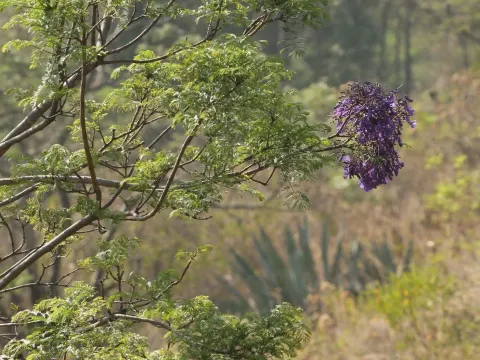
Jacaranda acutifolia
Jacaranda acutifolia
Propagation of Jacaranda acutifolia is primarily achieved through seeds or semi-hardwood cuttings. Seeds should be sown in a light, well-draining substrate during early spring, keeping the temperature between 22 and 25 degrees Celsius for optimal germination.
What the section contains
Jacaranda acutifolia
Seeds need only a thin layer of soil covering them, typically 0.5 to 1 cm deep. Maintaining high humidity by covering the container with plastic wrap is essential until the seedlings appear, which usually takes several weeks.
Once the seedlings have developed their first true leaves, they should be carefully pricked out into individual containers. It is important to use a high-quality, nutrient-rich potting mix to support early development.
Cutting propagation is best performed during the summer months. Selected stems are treated with rooting hormones and placed in a sand-peat mixture to encourage root growth while maintaining high ambient humidity.
Young plants require consistent monitoring of soil moisture. Repotting should be performed annually in the spring to accommodate the rapid root growth characteristic of this species.
As a member of the Bignoniaceae family, Jacaranda acutifolia originates from the tropical forests of South America. It is a highly light-demanding species that thrives in full sun, making it ideal for bright greenhouses or sunny locations.
The soil must be fertile, loose, and possess excellent drainage to prevent root asphyxiation. A balanced mixture of loam, peat, and coarse sand provides the ideal environment for the root system to expand healthily.
The plant prefers a stable temperature range between 20 and 28 degrees Celsius during the active growing season. During winter, it requires a cooling period with temperatures between 14 and 16 degrees to prepare for the next season.
Humidity management is crucial, especially in indoor environments. Frequent misting or the use of humidifiers helps maintain the lush foliage quality and prevents the leaves from becoming dry or brittle.
Regular fertilization with a balanced liquid fertilizer during the growing season is recommended to ensure robust growth. Always dilute fertilizers to avoid burning the sensitive root system.
Pests such as aphids, scale insects, and spider mites are common threats in closed environments, especially when air humidity is low. Regular inspection is necessary to catch and treat infestations early.
Root rot, often caused by overwatering or poor drainage, remains the most significant pathological threat. If the soil remains waterlogged, the roots will quickly deteriorate, leading to systemic plant decline.
Low light levels during the growing period result in etiolation, where the plant grows weak, spindly stems and sparse foliage. This reduces the plant's natural resistance to environmental stress and opportunistic pathogens.
Preventive maintenance, including keeping the foliage clean and ensuring adequate airflow, significantly reduces the probability of fungal outbreaks and pest colonization.
In cases of severe infestation, systemic insecticides are necessary. However, it is always safer to prioritize mechanical removal of pests and environmental adjustment before chemical intervention.