
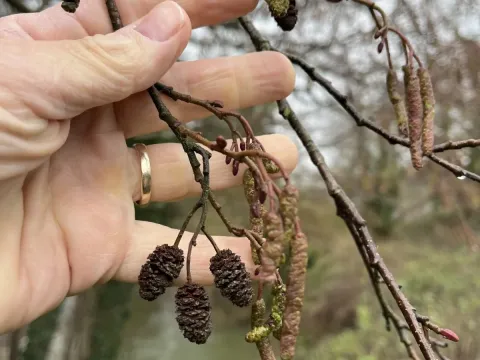
Alder
Alnus
Alder (Alnus), a member of the Betulaceae family, is a significant forestry crop known for its ecological benefits. These deciduous trees are unique in their ability to fix atmospheric nitrogen through a symbiotic relationship with actinobacteria, enhancing soil fertility.
What the section contains
 Alnus elliptica
Alnus spectabilis
Alnus spectabilis
Alnus elliptica
Alnus elliptica
Alnus spectabilis
Alnus spectabilis
 Alnus trabeculosa
Alnus trabeculosa
Alnus trabeculosa
 Arizona alder
Alnus oblongifolia
Arizona alder
Alnus oblongifolia
 Ascherson alder
Alnus aschersoniana
Ascherson alder
Alnus aschersoniana
 Caucasian alder
Alnus subcordata
Caucasian alder
Alnus subcordata
 Caucasian alder
Alnus barbata
Caucasian alder
Alnus barbata
 Downy alder
Alnus pubescens
Downy alder
Alnus pubescens
 Formosan alder
Alnus formosana
Formosan alder
Alnus formosana
 Green alder
Alnus alnobetula
Green alder
Alnus alnobetula
 Hybrid alder
Alnus hybrids
Hybrid alder
Alnus hybrids
 Japanese alder
Alnus firma
Japanese alder
Alnus firma
 Japanese alder
Alnus japonica
Koehne alder
Alnus koehnei
Japanese alder
Alnus japonica
Koehne alder
Alnus koehnei
 Manchurian alder
Alnus hirsuta
Manchurian alder
Alnus hirsuta
 Matsumura alder
Alnus matsumarae
Matsumura alder
Alnus matsumarae
 Maximowicz alder
Alnus maximowiczii
Maximowicz alder
Alnus maximowiczii
 Nepalese alder
Alnus nepalensis
Nepalese alder
Alnus nepalensis
 Oriental alder
Alnus orientalis
Oriental alder
Alnus orientalis
 Purpus alder
Alnus purpusii
Purpus alder
Alnus purpusii
 Seaside alder
Alnus maritima
Serrulate alder
Alnus serrulatoides
Seaside alder
Alnus maritima
Serrulate alder
Alnus serrulatoides
 Siebold's Alder
Alnus sieboldiana
Silesian alder
Alnus silesiaca
Siebold's Alder
Alnus sieboldiana
Silesian alder
Alnus silesiaca
 Sitka alder
Alnus sinuata
Sitka alder
Alnus sinuata
 Spath's Alder
Alnus spaethii
Spath's Alder
Alnus spaethii
 Thinleaf alder
Alnus tenuifolia
Thinleaf alder
Alnus tenuifolia
 White alder
Alnus rhombifolia
Woolly alder
Alnus lanata
White alder
Alnus rhombifolia
Woolly alder
Alnus lanata
Alder
The crop thrives in moist environments and is commonly found in riparian zones, wetlands, and near water bodies. Alder prefers fertile, well-drained loamy soils but can tolerate various soil textures as long as the water table is consistent and the soil aeration is adequate.
Alder is well-adapted to temperate climates and demonstrates strong frost resistance. While it is a light-demanding species, seedlings may tolerate partial shade during early growth stages, making forest management strategies focused on canopy thinning essential for optimal wood production.
Successful cultivation involves maintaining appropriate site conditions, particularly moisture levels. Planting healthy nursery-grown saplings with established root systems is recommended to ensure high survival rates, especially when reforesting degraded lands or abandoned agricultural fields.
Agronomic management of Alder often involves minimal fertilization due to the tree's nitrogen-fixing capabilities. Instead, the focus is on silvicultural practices such as thinning and pruning to promote clear, high-quality timber growth and to reduce competition for light and nutrients.
Alder wood is highly valued in the furniture industry, plywood production, and the creation of musical instruments. Its physical properties, particularly its resistance to decay under water, make it a traditional choice for construction in damp environments, including small bridges and dock piles.
Beyond timber, Alder is an essential component of soil restoration projects. By improving nitrogen levels and organic matter content in the soil, Alder plantations facilitate the recovery of degraded landscapes and prepare the site for subsequent forest rotations or agroforestry initiatives.
The most serious threat to Alder populations is Phytophthora, a root and bark disease that can lead to rapid crown dieback and tree death. Disease management primarily involves strict phytosanitary measures, including the removal and destruction of infected trees to prevent further spread.
Leaf-eating insects, such as the Alder leaf beetle, can cause significant defoliation, reducing the tree's vigor and biomass accumulation. In plantation settings, monitoring for pest density is crucial, and integrated pest management strategies are applied only when thresholds are exceeded.
Fungal infections such as rusts and various leaf spots can affect foliage quality during wet and warm seasons. Maintaining appropriate planting density ensures proper air circulation within the canopy, which effectively reduces the incidence of fungal pathogens in young plantations.