
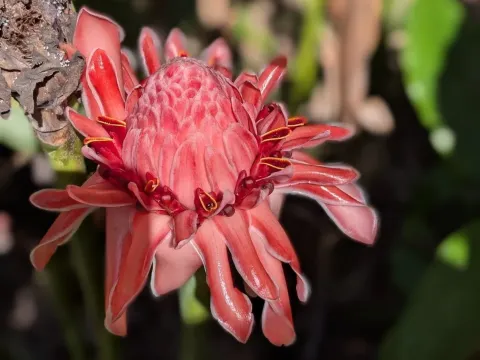
Etlingera
Etlingera
Etlingera belongs to the Zingiberaceae family. In agricultural conditions, the propagation of this crop is most often carried out by vegetative means — dividing the rhizomes, which allows for the preservation of the parent plant's varietal traits.
What the section contains


Etlingera
Planting of cuttings is conducted at the beginning of the rainy season when the soil temperature consistently stays between 22 and 25 degrees Celsius. It is crucial to choose areas with good drainage, as stagnant moisture during planting often leads to rhizome rot.
The planting depth of the rhizomes is approximately 10–15 centimeters. When planting, it is important to ensure that growth buds are facing upward and the soil around is slightly compacted to ensure firm contact with the roots.
Cultivation from seeds is practiced less frequently due to the long germination period, which can take up to 2–3 months. Seeds require preliminary stratification and should be sown in a light, moist substrate immediately after harvesting, as they lose viability quickly.
Planting density depends on the intended use: in industrial production for spices or flowers, a spacing of 1 to 1.5 meters between plants is maintained to ensure adequate bush ventilation.
Etlingera is a tropical plant that places high demands on climatic conditions. Successful growth requires an average annual temperature in the range of 25–30 degrees and the absence of sudden temperature fluctuations.
The crop is extremely demanding regarding air humidity, which should be maintained above 70–80%. In drought conditions, Etlingera growth slows down, and leaves begin to lose turgor and dry out at the edges.
Soils for cultivation must be fertile, rich in organic matter, with a slightly acidic reaction (pH 5.5–6.5). Loamy soils with a high humus content and excellent drainage characteristics are ideal.
The plant prefers partial shade, especially at a young age. Direct sunlight can cause burns on the leaf blades; therefore, agricultural practices often involve shading with nets or planting in wind-protected areas.
Regular fertilization with nitrogen-phosphorus-potassium fertilizers during the active growing season allows for the development of powerful above-ground mass. Special attention should be paid to the application of magnesium and micronutrients, which are necessary for the intense color of the inflorescences.
Etlingera is cultivated both for its decorative inflorescences (for example, in the Etlingera elatior species) and for edible inflorescences and young shoots. Yield depends heavily on the age of the plantation and the intensity of care.
The first commercial inflorescences can be expected 2–3 years after planting. Full fruit-bearing, when the bush provides maximum output, occurs at 4–5 years of root system development.
Commercial use includes the application of inflorescences as a cut flower crop, which is characterized by high vase life. In the cuisine of Southeast Asia, unopened buds are used, which possess a specific sour-spicy taste.
Rhizomes of many Etlingera species also find applications in pharmaceuticals and traditional medicine. Extracts from them have antibacterial and anti-inflammatory properties, which increases the value of the crop as a raw material resource.
When all agricultural standards are met, one plantation can be operated for 10–12 years, consistently producing inflorescences twice a year, depending on the local climate.
The main enemies of Etlingera are fungal diseases that develop against the background of excessive moisture. Root rot, caused by fungi of the Pythium and Fusarium genera, can lead to the death of the bush within a few weeks.
Among pests, spider mites are the most dangerous, as they actively multiply in conditions of high humidity and insufficient air circulation. They damage the lower part of the leaves, causing deformation.
Mealybugs often settle in the leaf axils and inflorescences, sucking juices and inhibiting the overall development of the plant. To control pest populations, both biological preparations and specialized insecticides are used.
An important element of prevention is strict adherence to sanitary standards on the plantation: timely removal of affected plant parts, use of healthy planting material, and control of soil acidity.
Water stagnation also provokes the development of leaf spots caused by pathogenic bacteria. Regular pruning of old shoots improves the microclimate within the plantings and significantly reduces the infection background.
Harvesting of inflorescences is performed in the phase when the buds are still tightly closed. This ensures maximum commercial appeal and a long storage life for the cut product during transportation.
For culinary purposes, inflorescences are cut with a sharp knife at the very base of the flower stalk. It is important to ensure that the cut is clean, without tissue tearing, which minimizes the risk of infecting the plant with fungal diseases through wounds.
When harvesting rhizomes, work is conducted during the plant's dormancy period, after the above-ground part begins to naturally yellow and die off. This ensures the maximum concentration of beneficial substances in the rhizomes.
After harvesting, inflorescences are placed in a cool place, avoiding direct sunlight. It is recommended to use special packaging to prevent moisture loss during the delivery process to the final consumer.
Post-harvest processing includes sorting by size and maturity. Quality sorting allows for efficient distribution of the product between flower markets and the food processing industry.