
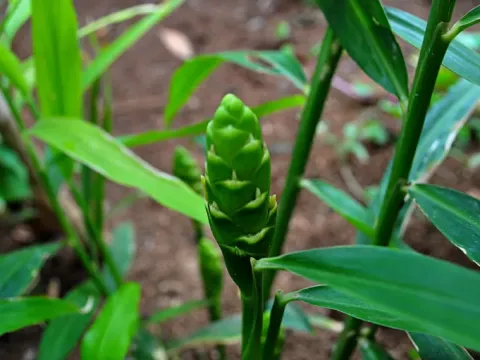
Ginger
Zingiber
Ginger (Zingiber officinale) is a herbaceous perennial plant belonging to the Zingiberaceae family. In agricultural practices, it is typically managed as an annual crop for rhizome production.
What the section contains
 Coral ginger
Zingiber corallinum
Golden ginger
Zingiber chryseum
Coral ginger
Zingiber corallinum
Golden ginger
Zingiber chryseum
 Green-yellow ginger
Zingiber viridiflavum
Green-yellow ginger
Zingiber viridiflavum
 Griffith's ginger
Zingiber griffithii
Griffith's ginger
Zingiber griffithii
 Hybrid ginger
Zingiber hybrids
Hybrid ginger
Zingiber hybrids
 Myoga
Zingiber mioga
Myoga
Zingiber mioga
 Red ginger
Zingiber rubens
Red ginger
Zingiber rubens
 Zingiber chrysanthum
Zingiber chrysanthum
Zingiber chrysanthum
 Zingiber clarkei
Zingiber clarkei
Zingiber clarkei
 Zingiber gracile
Zingiber gracile
Zingiber gracile
 Zingiber neglectum
Zingiber papuanum
Zingiber papuanum
Zingiber neglectum
Zingiber neglectum
Zingiber papuanum
Zingiber papuanum
 Zingiber puberulum
Zingiber puberulum
Zingiber puberulum
 Zingiber purpureum
Zingiber purpureum
Zingiber purpureum
 Zingiber striolatum
Zingiber striolatum
Zingiber striolatum
Ginger
The propagation of ginger is exclusively vegetative. It is carried out by planting pieces of mature, healthy rhizomes that possess viable growth buds or "eyes."
In tropical production regions, the planting cycle is aligned with the onset of the rainy season to provide consistent moisture for early root development.
In greenhouse settings, growers usually start planting in late winter. This ensures that the crop has a sufficient growing season to reach maturity before the onset of cooler, darker periods.
Rhizome pieces are planted at a depth of 5 to 10 centimeters, with buds facing upward, ensuring that the shoots emerge rapidly and uniformly across the field or bed.
Ginger is a warmth-loving crop. It thrives best in temperatures ranging from +22 to +30 degrees Celsius and requires a high level of humidity throughout the growth phase.
The soil must be fertile, rich in organic matter, and, most importantly, well-draining. Waterlogging is highly detrimental and frequently leads to rhizome rot.
Although ginger requires ample light, it is sensitive to intense, direct tropical sunlight. Many commercial growers utilize shading systems to prevent leaf scorching and excessive water loss.
Regular irrigation is vital during the period of rapid vegetative growth. However, watering should be reduced as the rhizomes reach maturity to encourage proper thickening.
Loose soil texture is crucial to allow the rhizomes to expand without resistance, which is why sandy loam soils are often considered ideal for ginger cultivation.
Yield potential in ginger depends heavily on the specific cultivar, soil fertility, and the length of the growing period, which typically spans 8 to 10 months.
Average commercial yields typically range from 15 to 25 metric tons per hectare, though intensive farming can achieve higher results under optimal conditions.
Maximizing yields requires a balanced fertilization program, with a strong focus on potassium, which is essential for rhizome development and quality.
Proper density management is another key factor; spacing must balance the need for high output with the necessity of ensuring airflow to prevent disease outbreaks.
After the harvest, the rhizomes lose weight due to moisture loss, so efficient drying and processing are essential to maintain the final marketable yield volume.
Fungal and bacterial diseases are the primary threats to ginger production, especially in environments with high humidity and poor soil drainage.
Key pathological challenges include:
- Fusarium yellows and rot, which cause wilting and systemic plant collapse.
- Bacterial wilt, a devastating disease that can spread rapidly through entire fields.
- Root-knot nematodes, which cause physical damage to the rhizome and lower its market value.
Various insect pests, such as ginger shoot borers, feed on the foliage and stems, directly impacting the photosynthetic capacity of the plant.
Integrated pest management strategies, such as strict crop rotation and the use of certified disease-free planting material, are essential for effective risk mitigation.
The harvest phase begins when the foliage starts to turn yellow and wither, indicating that the rhizomes have reached their full size and maturity.
Rhizomes are carefully excavated from the soil. Manual or mechanical digging must be gentle to avoid bruising the skin, which significantly affects storage life.
For the "young ginger" market, harvest occurs earlier, at around 5–6 months, resulting in rhizomes with thin skin and a milder, less fibrous flavor profile.
Post-harvest processing involves cleaning the soil, trimming the stems, and allowing the rhizomes to cure slightly in a shaded, well-ventilated area.
Storage requires precise conditions; ideally, ginger should be kept at +12 to +14 degrees Celsius with controlled humidity to prevent desiccation or fungal growth.