
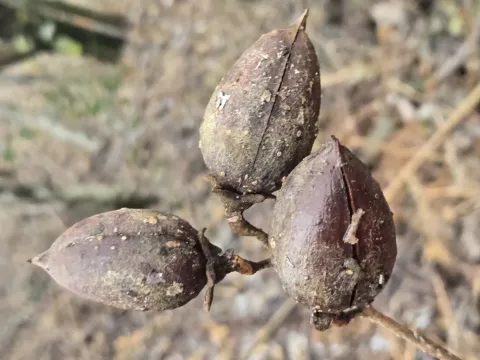
Paulownia
Paulownia Sieb. et Zucc.
Paulownia (Paulownia Sieb. et Zucc.) belongs to the Paulowniaceae family. In agriculture, it is typically propagated vegetatively using saplings (in vitro or cuttings), as seed propagation requires specialized control and conditions.
What the section contains
 Empress tree
Paulownia tomentosa (Thunb.) Steud.
Empress tree
Paulownia tomentosa (Thunb.) Steud.
 Hybrid Paulownia
Hybrids between Paulownia fortunei (Seem.) Hemsl., Paulownia tomentosa (Thunb.) Steud. and Paulownia elongata S. Y. Hu
Hybrid Paulownia
Hybrids between Paulownia fortunei (Seem.) Hemsl., Paulownia tomentosa (Thunb.) Steud. and Paulownia kawakamii T. Itô
Hybrid Paulownia
Hybrids between Paulownia fortunei (Seem.) Hemsl., Paulownia tomentosa (Thunb.) Steud. and Paulownia elongata S. Y. Hu
Hybrid Paulownia
Hybrids between Paulownia fortunei (Seem.) Hemsl., Paulownia tomentosa (Thunb.) Steud. and Paulownia kawakamii T. Itô
 Hybrid Paulownia
Paulownia fortunei (Seem.) Hemsl. x Paulownia tomentosa (Thunb.) Steud.
Hybrid Paulownia
Paulownia fortunei (Seem.) Hemsl. x Paulownia tomentosa (Thunb.) Steud.
 Paulownia catalpifolia
 T. Gong ex D. Y. Hong
Paulownia catalpifolia
Paulownia catalpifolia T. Gong ex D. Y. Hong
 Paulownia catalpifolia hybrid
Paulownia catalpifolia x Paulownia fortunei
Paulownia catalpifolia hybrid
Paulownia catalpifolia x Paulownia fortunei
 Paulownia elongata
 S. Y. Hu
Paulownia Elongata x Fortunei
Paulownia elongata S. Y. Hu x Paulownia fortunei (Seem.) Hemsl.
Paulownia elongata
Paulownia elongata S. Y. Hu
Paulownia Elongata x Fortunei
Paulownia elongata S. Y. Hu x Paulownia fortunei (Seem.) Hemsl.
 Paulownia fortunei
 (Seem.) Hemsl.
Paulownia fortunei x kawakamii
Paulownia fortunei (Seem.) Hemsl. x P. kawakamii T. Itô
Paulownia fortunei
Paulownia fortunei (Seem.) Hemsl.
Paulownia fortunei x kawakamii
Paulownia fortunei (Seem.) Hemsl. x P. kawakamii T. Itô
 Paulownia kawakamii
 T. Itô
Paulownia kawakamii
Paulownia kawakamii T. Itô
Paulownia
Planting saplings in open fields is conducted in the spring, once the threat of late frosts has passed and soil temperatures have reached 12–15 degrees Celsius.
Ensuring adequate moisture for the root system during the first few weeks after planting is essential for successful plantation establishment.
Planting density depends on the intended use: 4x4 or 5x5 meters is common for high-quality timber production, while denser patterns are used for biomass.
Selecting sites protected from strong winds is crucial, as they can cause significant physical damage to the fragile young shoots and large leaves of the plant.
This crop is light-loving and thermophilic, requiring intense solar radiation for rapid biomass accumulation and proper stem lignification.
Paulownia is demanding regarding soil quality, preferring light loams or sandy soils with deep groundwater levels and excellent aeration.
The soil pH should range between 5.0 and 8.5, as growth is significantly inhibited in highly acidic or saline soil environments.
Regular irrigation is necessary, especially during the first two years of growth, as water stress severely limits both growth rates and timber volume.
The plant adapts well to various climatic zones, provided that the chosen variety is selected based on the frost resistance required for the specific region.
Paulownia is recognized as one of the fastest-growing tree species globally, capable of reaching commercial timber size within 5–7 years of intensive cultivation.
The timber yield is determined by genetic quality, maintenance practices, irrigation efficiency, and the application of mineral fertilizers during the growing season.
With optimal agronomic practices, a plantation can produce up to 300–400 cubic meters of high-quality timber per hectare over a single production cycle.
After harvesting, Paulownia demonstrates strong coppicing ability, allowing the plant to regrow from the same root base for up to 4–5 consecutive cycles.
Commercial applications include the production of premium lumber, furniture, veneer, musical instruments, and high-energy wood pellets.
Young saplings are susceptible to fungal diseases such as root rot, which is often exacerbated by excessive soil moisture and poor drainage.
Pests, including certain types of caterpillars and leaf-eating insects, can damage leaf blades, thereby reducing the tree's overall photosynthetic efficiency.
In higher latitudes, late spring frosts pose the most significant threat, as they can damage young buds and delicate apical shoots.
Disease prevention involves maintaining proper irrigation schedules and avoiding excessive nitrogen fertilization towards the end of the summer season.
Regular plantation monitoring is required to identify pest outbreaks early and apply appropriate biological or chemical control measures when necessary.
Timber harvesting is conducted during the plant's dormant period, typically in late autumn or winter, when sap flow has significantly reduced.
To ensure successful regeneration from the root system, the stem is cut at a height of 5–10 centimeters above the ground surface.
Freshly harvested timber requires careful drying processes, as the high initial moisture content makes it susceptible to warping if storage technology is neglected.
When harvesting for biomass energy, the schedule may be adjusted based on the specific cycle of organic mass accumulation within the stems.
Utilizing specialized forestry equipment significantly improves harvesting efficiency, reduces labor costs, and maximizes the economic return of the crop.