
Hybrid Paulownia
Hybrids between Paulownia fortunei (Seem.) Hemsl., Paulownia tomentosa (Thunb.) Steud. and Paulownia elongata S. Y. Hu
Description
Sowing dates
Industrial planting of hybrid Paulownia is primarily performed vegetatively using seedlings with a closed root system. The optimal time for planting occurs after the threat of frost has passed and soil temperatures consistently stay above 10–12°C.
For most temperate regions, May is the preferred month for planting, allowing the root system to adapt to outdoor conditions before the onset of summer heat. Adequate site preparation, including deep plowing and the installation of a drainage system, is essential for healthy plant development.
Planting density depends on the specific purpose of the plantation; for high-quality timber, a density of 500 to 600 trees per hectare is generally recommended. Overcrowding increases competition for sunlight and nutrients, which significantly impairs trunk quality and growth rates.
Regular irrigation during the first month is crucial for survival. Implementing a drip irrigation system is highly advised to ensure uniform moisture delivery around the root ball, especially in sandy soils where water retention is low.
After the first year, a technical cut is mandatory. This practice involves cutting the tree back to ground level, which forces the root system to develop a much stronger, straighter, and faster-growing single trunk for the subsequent years of the production cycle.
Growing requirements
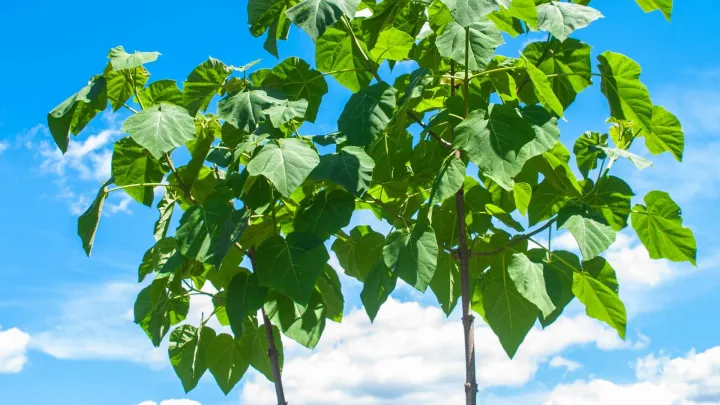
Hybrid Paulownia belongs to the Paulowniaceae family and is a product of crossbreeding between P. fortunei, P. tomentosa, and P. elongata. These hybrids have been optimized for faster biomass accumulation and improved resilience to varying climate conditions.
The culture is extremely light-demanding and does not tolerate shade. Plantation sites must be fully open, as any degree of canopy competition or shading will result in stunted, deformed trunks and reduced photosynthetic efficiency.
Well-drained sandy loam or loam soils with a pH between 6.0 and 7.5 are ideal for optimal development. Heavy clay soils that tend to become waterlogged are unsuitable, as they prevent oxygen from reaching the roots and trigger root rot pathogens.
Water requirements remain high throughout the tree's lifespan. While established Paulownia trees develop deep taproots, intensive timber production relies on consistent moisture levels, especially during the first three years of the tree's development.
Temperature tolerance varies by specific hybrid lineage, though most selected varieties can survive short-term frost down to -20...-25°C. Successful cultivation in cooler climates requires careful selection of winter-hardy genotypes adapted to the local environment.
Yield
The primary yield metric for Paulownia is the volume of commercial-grade timber per hectare. Under proper cultivation practices, these trees can reach a log diameter of 30–40 cm within just 6 to 8 years after the initial planting or technical cut.
Paulownia wood is highly valued for its exceptional strength-to-weight ratio, stability, and ease of processing. These features make it a preferred material for furniture, boat building, musical instruments, and high-end plywood manufacturing.
Beyond timber, the plantation provides secondary revenue streams through biomass. The leaves are rich in proteins and can be used as nutritious livestock feed or processed into high-quality organic compost to restore soil fertility.
Paulownia flowers are an excellent honey source. A hectare of mature Paulownia can produce hundreds of kilograms of high-quality, light-colored honey, enabling apiary operations to thrive on the plantation grounds during the spring flowering season.
The trees possess a strong capacity for regeneration; after harvesting, new trunks emerge from the existing root system. This allows for up to 4–5 harvest cycles from a single planting, dramatically increasing the long-term profitability of the investment.
Main diseases and pests
Young plantations are vulnerable to soil pests, such as white grubs or mole crickets, which can severely damage roots shortly after planting. Preventive soil treatment with appropriate insecticides is a standard practice to mitigate these risks.
Fungal diseases like anthracnose and powdery mildew are common in high-humidity conditions with poor airflow. Maintaining correct plant spacing and conducting timely sanitary pruning are essential methods for preventing the spread of these pathogens.
Rodents, particularly hares and mice, may damage the bark of young trees during winter. Installing protective mesh sleeves or plastic guards is a necessary measure to shield the trunk from mechanical damage until the bark hardens.
Monitoring for signs of lichen growth on the bark is recommended, as it can create a microenvironment conducive to secondary fungal infections. Maintaining healthy, vigorous trees through proper fertilization and care remains the best natural defense against pests.
Systemic viral diseases, often transmitted by insects, can slow growth and degrade wood quality. If a plant shows symptoms of systemic stress or necrosis, it should be promptly removed and incinerated to protect the health of the remaining plantation.
Harvesting
Harvesting is performed during the biological dormancy phase in late autumn or early spring when sap flow is minimal. This timing ensures the highest quality of wood, reducing the risk of splitting and facilitating faster kiln drying after sawing.
Professional logging equipment or chainsaws are used for harvesting. The trees are cut as close to the ground as possible, leaving only a 5–10 cm stump, which is critical for ensuring that the root system can produce a new, robust shoot for the next cycle.
Logs are immediately sorted by diameter and quality before being sent to sawmills. Proper drying in kilns to reach a moisture content of 8–10% is essential for meeting international commercial standards for furniture-grade lumber.
Wood waste, including branches and canopy remnants, is processed into wood chips for biofuel production. Due to the high calorific value of Paulownia wood, these chips are highly efficient for fueling industrial heating systems and pellet production.
Effective logistics and harvest scheduling are vital to maximizing the economic return. Streamlining the transport of logs and the utilization of by-products ensures that the plantation maintains continuous productivity and remains a profitable enterprise.