
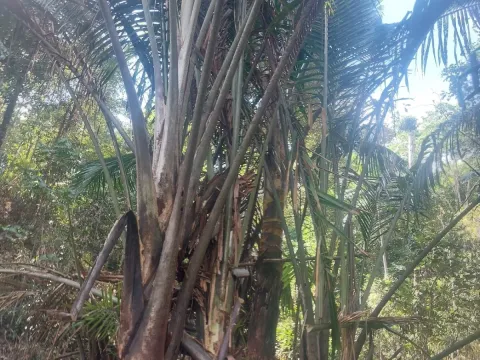
Sago palm
Metroxylon
The Sago palm, scientifically known as Metroxylon, is a genus of tropical palms in the Arecaceae family. It is highly valued for its ability to accumulate large reserves of starch in its trunk. These plants are monocarpic, meaning they flower and fruit only once before dying, which triggers a biological strategy of maximizing energy storage throughout their lifespan.
What the section contains

Sago palm
The cultivation of Metroxylon is centered in equatorial regions where high temperatures and significant rainfall are constant. The palm thrives in environments that provide consistent heat between 25°C and 30°C. It lacks cold tolerance, and any exposure to freezing or even cool weather can severely hinder its physiological development.
Regarding soil, Sago palms are unique in their preference for wetlands, peat swamps, and areas prone to periodic inundation. Unlike many other crops that suffer from waterlogging, Metroxylon species have evolved to thrive in oxygen-poor, saturated soils. Proper management of water levels is the most critical factor in ensuring healthy plantation growth.
Productivity per hectare for Sago palms is exceptionally high due to the density of starch storage within the trunk. A single mature palm can yield several hundred kilograms of raw starch. This efficiency makes it one of the most reliable food sources in regions where traditional grain farming is difficult or impossible due to soil saturation.
Management of the plantation often relies on the palm's natural vegetative propagation. As the main stem is harvested, the suckers produced at the base take over, maintaining the continuity of the stand. By managing these clusters, farmers ensure a sustainable yield of starch over several generations of the same plant rootstock.
Harvesting takes place just before the inflorescence emerges, as this is when starch content in the pith is at its maximum. The trunk is felled and debarked to access the internal starch-rich pith. This material is pulverized, often using mechanized rasping machines or traditional wooden tools, to break the structural fibers.
The final extraction involves washing the pulverized pith with water to separate the starch from the fibrous waste. The resulting starch suspension is allowed to settle, after which the water is drained, and the product is dried. The final yield is a clean, white starch that is versatile for both food consumption and various industrial applications.