
Smitinandia
Smitinandia
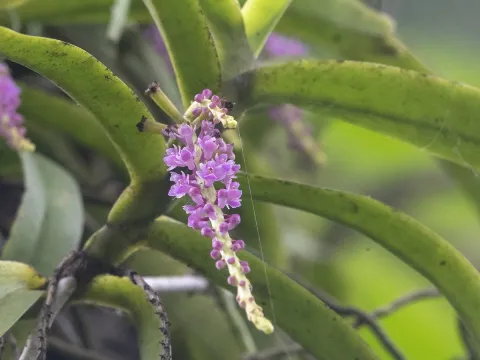
Smitinandia is a genus of monopodial epiphytic plants belonging to the Orchidaceae family. These plants are uniquely evolved to thrive in the canopy layer of tropical forests, where they anchor themselves to tree trunks and branches, gathering moisture from atmospheric humidity and nutrients from organic debris trapped in bark crevices.
What the section contains


Smitinandia
The natural habitat of this genus is found in Southeast Asia, with a distribution range that includes Thailand, Vietnam, and surrounding tropical regions. They prefer environments with consistent year-round warmth and high relative humidity, typical of humid forest ecosystems where the plants can maintain active growth cycles.
Botanically, Smitinandia is characterized by a compact stem with leathery, narrow, two-ranked leaves. The inflorescences emerge from leaf axils, displaying numerous small but structurally complex flowers. The root system is covered in a specialized layer of cells called velamen, which allows for rapid absorption and storage of water from the air.
To cultivate Smitinandia successfully, growers must provide bright, filtered light. Direct sun exposure must be strictly avoided, as it can cause irreversible tissue damage to the leaves. Proper shading is a critical agronomic requirement to mimic the natural light conditions found under the forest canopy.
Optimal environmental conditions include a temperature range of 18°C at night to 28°C during the day, accompanied by constant air circulation. Epiphytes like Smitinandia require a substrate-free environment, such as bark mounts or open baskets, to ensure that the roots have maximum access to airflow and can dry out appropriately between misting sessions.
Fungal and bacterial diseases are the primary threats to Smitinandia, usually triggered by poor ventilation coupled with excessive moisture. When water accumulates in the leaf axils or the center of the growth point, it creates an anaerobic environment that fosters rapid pathogen spread, often leading to crown rot.
Spider mites are common pests that thrive in warmer, less humid conditions. By feeding on plant sap, they cause leaf stippling and general decline, which inhibits the plant's ability to photosynthesize effectively. Regular monitoring of the undersides of leaves is essential for early detection and mitigation.
Mealybugs also pose a significant risk, hiding in tight spaces between leaves where they are difficult to reach with standard surface sprays. Their feeding habits can lead to localized cell death and invite secondary fungal infections, which further degrade the overall health of the orchid specimen.
Management of these threats involves a combination of improved sanitation, strategic pesticide application, and strict humidity control. It is vital to use only systemic treatments that are documented to be safe for orchid species to avoid damaging the delicate root systems or the velamen layer.
Proper fertilization is equally important for maintaining plant immunity against pests and diseases. Providing dilute, balanced orchid fertilizer throughout the growing season ensures the plant has the necessary energy to support healthy growth; conversely, over-fertilization can result in salt buildup that stresses the plant and predisposes it to infection.