
Description
Symptoms
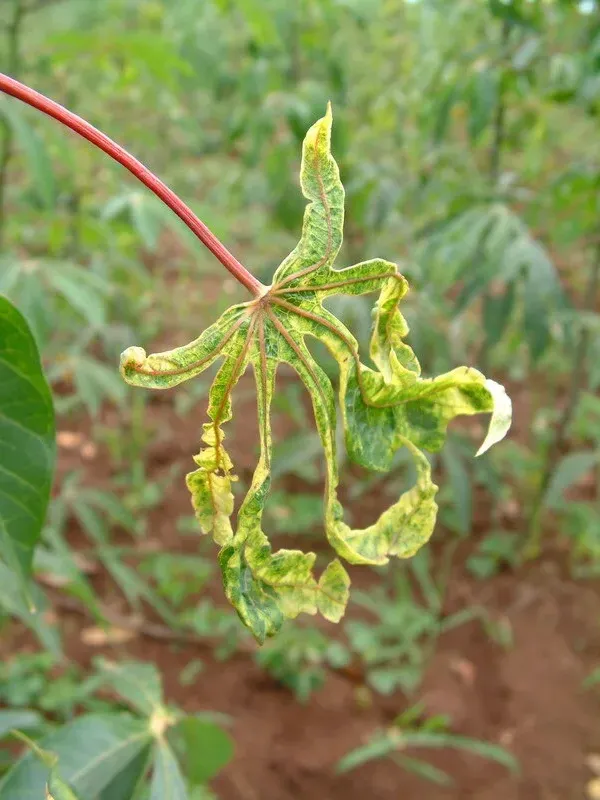
The primary symptom of cassava mosaic is a distinct mosaic pattern on leaves, manifesting as yellow or pale green patches contrasting with normal green tissue.
Leaves often exhibit severe deformation, distortion, and wrinkling, which significantly hinders the plant's photosynthetic capability and development.
Infected plants show stunted growth with shortened internodes, resulting in a reduced overall size compared to healthy, robust cassava plants.
Severely affected terminal shoots may develop a characteristic rosette shape, with twisted, small, and chlorotic leaves bunching together at the tips.
Symptoms are usually most apparent on young, rapidly growing leaves, serving as an early indicator for farmers to inspect their fields.
Pathogen
The disease is caused by a group of viruses belonging to the Geminiviridae family, most notably the African cassava mosaic virus (ACMV).
These pathogens are single-stranded DNA viruses that replicate within the plant's cells, systematically disrupting metabolic processes and chlorophyll synthesis.
The virus moves through the phloem of the plant, spreading from the site of inoculation throughout the entire plant system, including stems and storage roots.
The whitefly (Bemisia tabaci) serves as the principal vector, transmitting the viral particles while feeding on the phloem sap of the cassava plant.
In addition to insect transmission, the virus is widely disseminated through infected cuttings, making the selection of planting material critical.
Conditions for development
The disease spread is closely linked to the population density of whiteflies, which thrive and multiply rapidly in hot and dry climates.
Continuous cultivation of cassava on the same land without adequate crop rotation patterns facilitates the persistence and buildup of the virus in the environment.
High temperatures accelerate the life cycle of the vector, leading to increased frequency of feeding and higher transmission rates within the field.
Lack of spatial isolation between new plantings and older, already infected fields provides a constant source of inoculum for the whitefly vectors.
Stress factors such as drought or poor soil nutrition can further weaken the plant's defense mechanisms, making them more susceptible to viral infections.
Why it matters
The most significant impact of the disease is a drastic reduction in the yield of tuberous roots, which are the primary food source and economic product.
Yield losses can reach up to 80 percent in susceptible varieties, creating serious food security challenges in regions that rely heavily on cassava cultivation.
Beyond quantity, the quality of the harvested tubers is often compromised, showing lower starch content and poor overall post-harvest durability.
Infected plants display a weakened physiological state, making them prone to secondary infections and reducing their resilience to environmental stresses.
Total crop failure in highly susceptible fields can force farmers to abandon cultivation or undertake costly replacement of planting stocks with resistant cultivars.
Protection
The implementation of resistant or tolerant cassava varieties is considered the most sustainable and effective strategy for managing the disease.
Strict phytosanitary practices during the selection of stem cuttings are essential to ensure that only pathogen-free material is used for propagation.
Managing whitefly populations through appropriate insecticide applications can effectively slow down the spread of the virus within the field.
Rogueing, the practice of identifying and removing symptomatic plants immediately, helps to lower the viral inoculum pressure and protect neighboring healthy plants.
Adopting national quarantine regulations regarding the movement of cassava cuttings is vital to prevent the introduction of new viral strains into disease-free areas.
Pathogens and affected parts
Affects crops · 1
Discussion
No discussions yet — be the first.