
Description
Symptoms
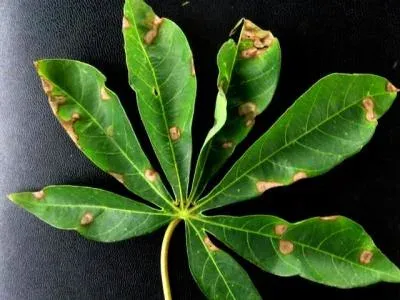
The initial symptoms appear on the lower, older leaves as small, dark brown spots. These spots are usually regular in shape and delimited by leaf veins.
As the disease progresses, the spots expand and may merge, often surrounded by a chlorotic (yellow) halo, which indicates the plant's stress response.
A characteristic feature of the disease is the presence of grayish or brown fungal growth on the underside of the leaves, corresponding to the pathogen's sporulation.
In severe infections, the affected leaves yellow and drop prematurely. This results in significant defoliation, leaving only the younger leaves at the top of the stem.
While the disease mainly affects leaves, heavy infection can weaken the entire plant structure, impacting its overall development.
Pathogen
The disease is caused by the fungus Mycosphaerella henningsii (its anamorph stage is Cercospora henningsii). This pathogen is a major fungal threat to cassava cultivation globally, particularly in tropical regions.
The fungus produces spores (conidia) that are easily disseminated by wind, rain splashes, and movement of farm equipment through the fields.
It overwinters as mycelium and dormant structures on infected crop debris, which acts as a primary inoculum source for the next growing season.
Upon germination, the fungus enters the leaf through stomata or wounds. Once inside, it colonizes the tissue, resulting in characteristic necrotic lesions.
The pathogen's life cycle is closely synchronized with the host's physiological stages, becoming more aggressive as the plant matures and the canopy thickens.
Conditions for development
High relative humidity and warm temperatures (ranging from 25°C to 30°C) create an ideal environment for the proliferation of Mycosphaerella henningsii.
Frequent rainfall and dew periods prolong leaf wetness, which is critical for spore germination and the successful colonization of leaf tissues.
Dense planting patterns reduce air circulation within the canopy, leading to a microclimate that strongly favors fungal infection and rapid spread.
Poor soil fertility, especially deficiencies in potassium and nitrogen, makes cassava plants more susceptible to the impact of the disease.
The presence of infected plant residues from previous seasons provides the necessary inoculum to trigger an outbreak when climatic conditions become favorable.
Why it matters
The primary impact of brown leaf spot is the reduction of the plant's photosynthetic capacity due to premature leaf loss.
Since leaves are the primary source of starch accumulation for the tubers, significant defoliation leads to a substantial decrease in yield, often by 20% or more.
The disease also degrades the quality of the planting material, as cuttings taken from infected plants may show reduced vigor and lower survival rates.
Affected plants are less able to withstand environmental stressors, such as drought or secondary pest infestations, further compromising crop productivity.
Continuous infection cycles in monoculture systems can lead to long-term degradation of the land's potential for cassava production.
Protection
The most effective management strategy involves the use of resistant or tolerant cassava varieties tailored to the specific agro-ecological zone.
Sanitation practices, such as the removal and destruction of infected crop debris, are essential to reduce the inoculum level for future plantings.
Maintaining proper plant spacing helps improve airflow and reduces humidity, which can significantly limit the spread of the fungal pathogen.
Balanced fertilization, particularly ensuring adequate potassium, helps the plant build stronger leaf tissues that are more resistant to infection.
- Implementing crop rotation to break the pathogen's infection cycle.
- Using clean, healthy stems for vegetative propagation.
- Applying fungicides when the disease intensity threatens commercial yields.
Pathogens and affected parts
Affects crops · 1
Discussion
No discussions yet — be the first.