
Description
How to tell it apart
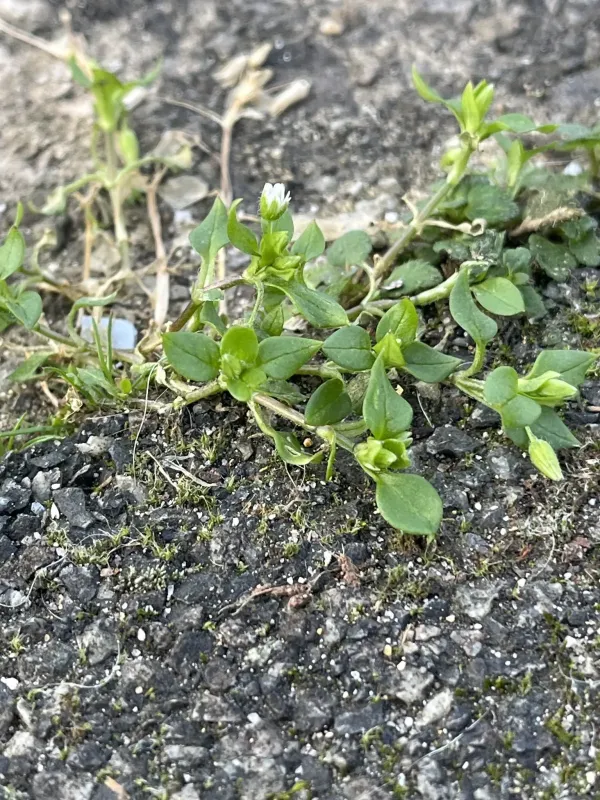
Common chickweed, scientifically known as Stellaria media, belongs to the Caryophyllaceae family. It is an annual herbaceous plant with sprawling, branched stems that easily root at the nodes.
The leaves are small, ovate, and pointed. A distinct diagnostic feature is the single line of fine hairs running along the stem, which helps distinguish it from similar species.
The flowers are small, white, and deeply cleft, often appearing as ten petals. The plant is prolific, capable of flowering and setting seeds throughout most of the growing season.
The fruit is a multi-seeded capsule that splits into six valves upon maturity. A single plant can produce up to 25,000 seeds, which can remain viable in the soil for a decade.
One of its primary biological advantages is the ability to germinate at very low temperatures, starting at +2...+4 degrees Celsius, allowing it to dominate early in the season.
Where it grows
This weed is a cosmopolitan species that thrives in moist, nutrient-rich soils. It prefers shaded areas but is highly adaptable to open fields and various agricultural environments.
Common chickweed frequently infests winter cereal crops, vegetable gardens, potato fields, and permanent pastures. It is especially aggressive in dense crop stands.
The presence of chickweed is often an indicator of excessive soil moisture. In highly infested areas, it forms a thick mat that prevents proper soil aeration and light penetration.
It spreads rapidly in crop rotations that include fallow land or where cultivation practices are inconsistent. It easily withstands light frost, gaining a head start over crops.
Seeds are dispersed via wind, water movement, manure application, and movement of contaminated farm machinery between different fields.
Harm it causes
The main damage caused by chickweed is intense competition for moisture, light, and soil nutrients. Because of its rapid growth, it suppresses young seedlings of crops.
Chickweed serves as a reservoir for various plant pathogens and pests, including rust, powdery mildew, and several species of parasitic nematodes that attack crops.
The dense vegetative mat increases humidity in the microclimate near the soil, which promotes the development of root rots and fungal diseases in dense cereal or vegetable crops.
The weed makes manual and mechanical operations, such as weeding, hilling, and harvesting, much more difficult and costly. Crop contamination reduces overall market value.
Its massive seed production and ability to propagate vegetatively mean that once established, chickweed requires a long-term, multi-year strategy to manage effectively.
How to control
Agrotechnical control methods include consistent crop rotation, precise row cultivation, and deep plowing to bury seeds at depths that inhibit successful germination.
A key technique is to promote seed germination with early spring harrowing, followed by the eradication of the weed seedlings before they can set new seeds.
Chemical control involves the use of selective herbicides. The choice of active ingredient depends heavily on the specific crop and the growth stage of the weed.
- Applying sulfonylurea-based herbicides for cereal crop protection.
- Using pre-emergence soil-applied herbicides in vegetable production systems.
- Implementing regular field monitoring to prevent weed plants from flowering and dispersing seeds.
An integrated approach that combines mechanical cultivation with timely herbicide applications is the most effective way to deplete the soil seed bank over several seasons.
Content graph
Connections · Common chickweed
Most often together:
Marketplace
Products · 841


Belveder Forte
Finkemü Schwebda, F.GmbH, GERMANY, MEMBER OF GROUP
Herbicides
0
0
·
959
11 offers
15.9 €per 1 l
Buy


TriO Lux
Ф.Суперус Ко ., Лтд., Гонг-Конг, Шанхай, Китай.
Herbicides
0
0
·
920
2 offers
150.8 €per pack
Buy


Controller
Ф.Меатон Лімітед, Лондон, Великобританія.
Herbicides
0
0
·
748
2 offers
40.19 €per pack
Buy

Consultant
Джянгсу Агрохем Лабораторі Ко. Лтд., Чанжоу, Китай
Herbicides
0
0
·
655
1 offer
5.68 €per pack
Buy


Tronomit, WG ( rimsulfuron, 250 g/kg)
Unicity Enterprises L.P.
Herbicides
0
0
·
190
6 offers
63.45 €per 1 l
Buy

ALPHA-STAR V.G.
Ф.Меатон Лімітед, Лондон, Великобританія.
Herbicides
0
0
·
163
4 offers
30.48 €per 1 l
Buy


NOPASARAN K.S.
ф.БАСФ СЕ, Німечина на заводі м.Гравелін
Herbicides
0
0
·
101
2 offers
26.38 €per 1 l
Buy


Caméo 75, w.g., (Tribenuron-methyl, 750 g/kg)
DuPont de Nemours
Herbicides
0
0
·
90
3 offers
15.44 €per 1 l
Buy


Gladiator, CS (metamitron, 700 g/l)
Unicity Enterprises L.P.
Herbicides
0
0
·
82
1 offer
18.36 €per 1 l
Buy


DICBAN, RK
Ф.Суперус Ко ., Лтд., Гонг-Конг, Шанхай, Китай.
Herbicides
0
0
·
78
2 offers
11.24 €per 1 l
Buy


Dublon Super, WG
ZAT «August-Bel», Republic of Belarus
Herbicides
0
0
·
75
1 offer
32.5 €per 1 l
Buy


Dissulam, SE
Jiangsu Institute of Ecomones Co., Ltd.
Herbicides
0
0
·
74
23 offers
0.93 €per 1 l
Buy


Bentazone 480 g/l, (Bentazone 480 g/l)
Sharda Worldwide Exports Pvt Ltd, Sharda World
Herbicides
0
0
·
72
2 offers
8.64 €per 1 l
Buy


Triton
Три Дельта Компані Інтернешнл, Гонконг, Китай.
Herbicides
0
0
·
66
1 offer
6.72 €per pack
Buy


Alpha-Maïs, WG, herbicide + PAR «Alfalip»
Alpha Smart Agro
Herbicides
0
0
·
65
13 offers
2.99 €per 1 l
Buy

Biology
Taxonomy
- Latin name
- Stellaria media
- Family
- Однолетние двудольные сорняки