

DEFAULT
«Нанджин Ессенс Файн-Кемікал Ко. Лтд» (Китай)
Herbicides
0
0
·
58
8 offers
28.75 €per 1 l
Buy
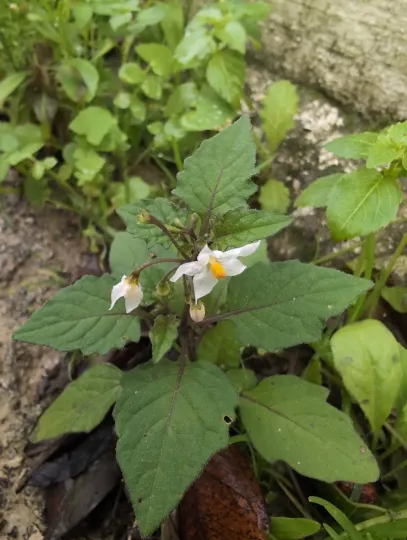
Black nightshade (Solanum nigrum) is an annual herbaceous plant belonging to the Solanaceae family. It typically grows up to 60 cm in height.
The leaves are alternate, ovate or rhombic in shape, with entire or coarsely toothed margins. The surface is generally smooth with few hairs.
Flowers are arranged in small clusters, featuring white petals and yellow anthers that form a cone shape in the center of the blossom.
The fruit is a small, round, juicy berry that turns from green to black or dark purple upon reaching maturity, containing many small seeds.
Its root system is taprooted and well-branched, allowing the plant to compete efficiently for nutrients and moisture in various soil types.
Black nightshade is widespread globally, thriving in disturbed habitats, rich garden soils, and agricultural fields with high nitrogen content.
It frequently colonizes row crops, such as corn, soybeans, tomatoes, and potatoes, exploiting the spaces between crop rows after cultivation.
This weed is often found along field edges, irrigation ditches, and areas where human activity has disrupted the natural vegetation cover.
It prefers warm, sunny conditions and is particularly persistent in fields that are irrigated, providing consistent moisture for growth.
The plant has a long growth period, germinating throughout the season whenever environmental conditions allow, making it a persistent nuisance.
Black nightshade competes directly with crops for essential resources, often reducing yield significantly if allowed to establish early in the season.
It acts as an alternative host for several economically significant plant viruses and fungal diseases that affect major commercial crops.
The berries can contaminate harvested grain or fruit, potentially leading to quality deductions or processing issues due to toxicity concerns.
The presence of this weed increases the difficulty of mechanical harvesting, as the biomass can clog machinery and affect harvest speed.
Because each plant produces thousands of seeds, failure to control early populations leads to a massive, long-term soil seed bank accumulation.
Effective management begins with mechanical control, including timely cultivation between crop rows to uproot young seedlings before they flower.
Crop rotation helps break the cycle, as different planting patterns and varying herbicide programs can reduce the population density over time.
Chemical control involves the application of pre-emergence or post-emergence herbicides, selected according to the specific crop and stage.
It is vital to maintain field hygiene by removing plants from field margins and non-crop areas to prevent seed dispersal by wind or water.
Early intervention is crucial because older, more mature plants develop a woody stem and become significantly more resistant to standard herbicides.


