

Description
How to tell it apart
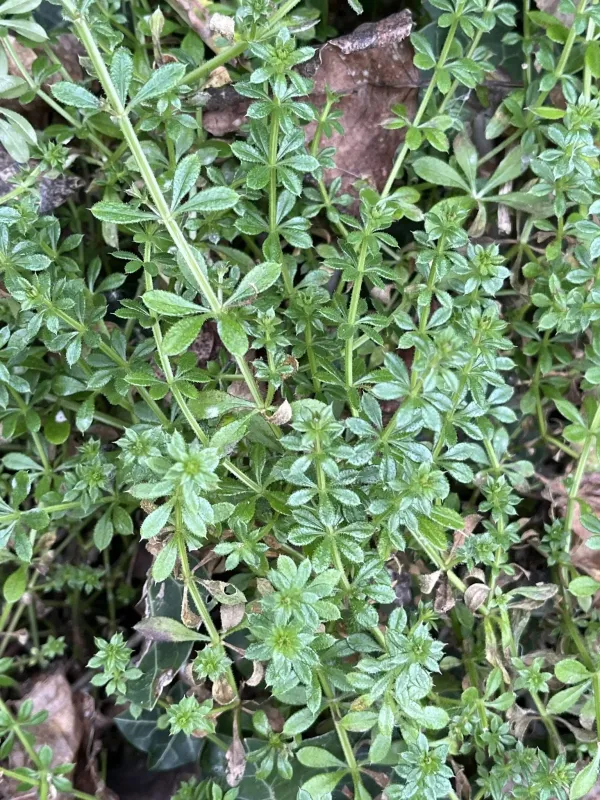
Cleavers (Galium aparine) is an annual herbaceous weed belonging to the Rubiaceae family. It is easily identified by its square stems and characteristic hooked hairs that cover the entire plant.
The leaves are narrow and linear, arranged in whorls of 6 to 8 around the stem. These leaves, along with the stems, are covered in small, backward-curving prickles, which give the plant its characteristic sticky, clinging texture.
The plant produces small, white, star-shaped flowers that bloom in late spring and early summer. These flowers develop into burr-like seeds covered in hooked bristles.
These hooked seeds readily attach to animal fur, clothing, and agricultural machinery, facilitating rapid distribution across fields and between different agricultural plots.
The root system is fibrous and relatively shallow, allowing the plant to draw nutrients from the upper soil horizon effectively during the early stages of crop development.
Where it grows
Cleavers are widely distributed across temperate regions globally. They thrive in moist, nutrient-rich soils, particularly those high in nitrogen, making them a common sight in fertile agricultural lands.
They are frequently found in winter and spring cereals, oilseed rape, sugar beet, and various horticultural crops. Their preference for nitrogen makes them particularly aggressive in well-fertilized fields.
The plant is highly adaptable and can colonize various environments, including field margins, hedge bottoms, and disturbed waste ground, which serve as reservoirs for future infestation.
Seeds can remain viable in the soil for up to several years, ensuring the persistence of the seed bank even when cultural practices are used to suppress the plant for a season.
The ability of cleavers to grow rapidly in the cool, moist conditions of early spring often gives them a head start over many seeded crop species.
Harm it causes
The primary economic impact of cleavers is their tendency to cause crop lodging. By physically clinging to cereal stalks, they weigh down the crop, making it collapse and complicating mechanical harvesting.
They act as aggressive competitors for light, water, and essential soil nutrients. In severe infestations, they can significantly reduce the biomass and yield potential of the primary crop.
The dense matting growth habit of cleavers can effectively smother young crop seedlings, restricting their access to sunlight and delaying development during critical growth stages.
Contamination of harvested grain with cleaver seeds is a significant quality issue. Their size and weight make them difficult to remove during standard seed cleaning processes.
Furthermore, cleavers can serve as alternative hosts for various pests and diseases that affect commercial crops, potentially leading to increased reliance on pesticides.
How to control
Agronomic control includes practices such as proper crop rotation, which breaks the lifecycle of the weed, and the use of competitive crop varieties that cover the soil quickly.
Strategic cultivation, such as stale seedbed preparation, can encourage the germination of cleaver seeds, which can then be destroyed by mechanical weeding before the primary crop is sown.
Chemical control remains a cornerstone of management. Post-emergence herbicides are most effective when applied at the seedling stage, specifically before the plants develop more than three whorls of leaves.
The use of effective herbicide tank mixes, often incorporating adjuvants to overcome the plant's waxy and hairy surface, is essential for ensuring maximum uptake and consistent efficacy.
- Monitor fields for early emergence.
- Use certified clean seed.
- Apply herbicides during the early seedling stage.
Content graph
Connections · Cleavers
Most often together:
Marketplace
Products · 712


GALERA SUPER, RK
Доу АгроСайенсіс С.А.С., Друзенхайм, Франція
Herbicides
0
0
·
37
4 offers
41.27 €per 1 l
Buy


Ksior, KS, herbicide
ТОВ «Франдеса» , Республіка Білорусь
Herbicides
0
0
·
37
1 offer
48.58 €per pack
Buy


Caré z.p., (Methyl triflusulfuron 500 g/kg)
Сінокем Хебеї Корпорейшн, м.Шийяжуанг, Китай
Herbicides
0
0
·
37
2 offers
65.24 €per 1 l
Buy


Express 75 WG
«Дюпон Інтернешнл Оперейшнз Сарл», Швейцарія
Herbicides
0
0
·
36
2 offers
207.12 €per 1 l
Buy

Kaptor, RK, (Imazamox, 33 g/l + Imazapir, 15 g/l)
BASF Agro B.V.
Herbicides
0
0
·
36
2 offers
30.96 €per 1 l
Buy


Pristar, WG (tribenuron-methyl, 750 g/kg)
Unicity Enterprises L.P.
Herbicides
0
0
·
35
3 offers
16.71 €per 1 l
Buy


Stefarane, EC (fluroxypyr in the form of methylheptyl ester, 333 g
ДДЕ Фарм АГ, Тризен, Ліхтенштейн
Herbicides
0
0
·
35
1 offer
25.49 €per 1 l
Buy


2,4-D-star
ТОВ «Фабрика агрохімікатів», Черкаси, Україна
Herbicides
0
0
·
35
1 offer
7.31 €per 1 l
Buy

Globstar
ДВА Кемікалс Ко. Лтд., Китай (DVAChemicalsCo.Ltd.),China;
Herbicides
0
0
·
35
2 offers
10.81 €per pack
Buy


YUNI-FLORA 250, WG
Wuxi UnitChem Co., Ltd., Jiangsu, КНР
Herbicides
0
0
·
34
1 offer
49.82 €per 1 l
Buy

Flagman, herbicide, (bentazon, 480 g/l)
Agrochemical Factory, LLC
Herbicides
0
0
·
34
2 offers
8.48 €per 1 l
Buy

MONITOR, WG, (Sulfosulfuron, 750 g/kg)
Монсанто Європа С.А., Антверпен, Бельгія
Herbicides
0
0
·
34
1 offer
1 857.67 €per 1 l
Buy

VIVO, SE
ТОВ «Фабрика агрохімікатів», Черкаси, Україна
Herbicides
0
0
·
34
1 offer
10.14 €per 1 l
Buy


Agriter Super 500 RK
Фадер Альянс Лтд., Великобританія (Fader Alliance Ltd., England) на заводах Нідерландів, Польщі
Herbicides
0
0
·
33
1 offer
1.17 €per 1 l
Buy

Teson 622 SE
Фадер Альянс Лтд., Великобританія (Fader Alliance Ltd., England) на заводах Нідерландів, Польщі
Herbicides
0
0
·
33
3 offers
6.56 €per 1 l
Buy

Flumet, WG, herbicide (flumetsulam, 800 g/kg)
Jiangsu Agricoem Laboratory Co., Ltd.
Herbicides
0
0
·
33
6 offers
98.59 €per 1 l
Buy

Prima Forte, SE
Доу АгроСайенсіс С.А.С., Друзенхайм, Франція
Herbicides
0
0
·
33
16 offers
8.87 €per 1 l
Buy


Neolit z.p. (triflusulfuron-methyl, 500 g/kg)
Ф.Суперус Ко ., Лтд., Гонг-Конг, Шанхай, Китай.
Herbicides
0
0
·
33
2 offers
118.56 €per 1 l
Buy


Ballerina, SE (2-ethylhexyl ester of 2,4-dichlorophenoxyacetic acid
ZAT «August-Bel», Republic of Belarus
Herbicides
0
0
·
32
1 offer
0.19 €per 1 l
Buy

Bantene, RK (bensulfuron-methyl, 480 g/l)
Hangzhou Ruijiang Chemical Co., Ltd.
Herbicides
0
0
·
32
1 offer
192.95 €per pack
Buy


Metamitron-Star
ТОВ «Фабрика агрохімікатів», Черкаси, Україна
Herbicides
0
0
·
32
1 offer
9.41 €per 1 l
Buy

Stefcloram, RK (cloquarid, 267 g/l + picloram, 67 g/l)
ДДЕ Фарм АГ, Тризен, Ліхтенштейн
Herbicides
0
0
·
31
1 offer
14.62 €per 1 l
Buy
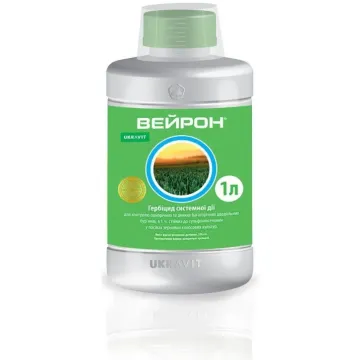
Weiron, KS (flumetsulam, 120 g/l + florasulam, 80 g/l)
ТОВ «Фабрика агрохімікатів», Черкаси, Україна
Herbicides
0
0
·
31
1 offer
65.18 €per 1 l
Buy
Biology
Taxonomy
- Latin name
- Galium aparine
- Family
- Однолетние двудольные сорняки