

Description
How to tell it apart
Hedge bindweed (Calystegia sepium) belongs to the Convolvulaceae family. It is a perennial herbaceous plant classified as a persistent, deep-rooted weed.
The plant features a long, branching white rhizome system that can penetrate up to 50 cm into the soil, allowing for rapid regeneration after disturbance.
Its stems are twining and can grow up to 3 meters in length. The leaves are arrow-shaped and arranged alternately on long petioles.
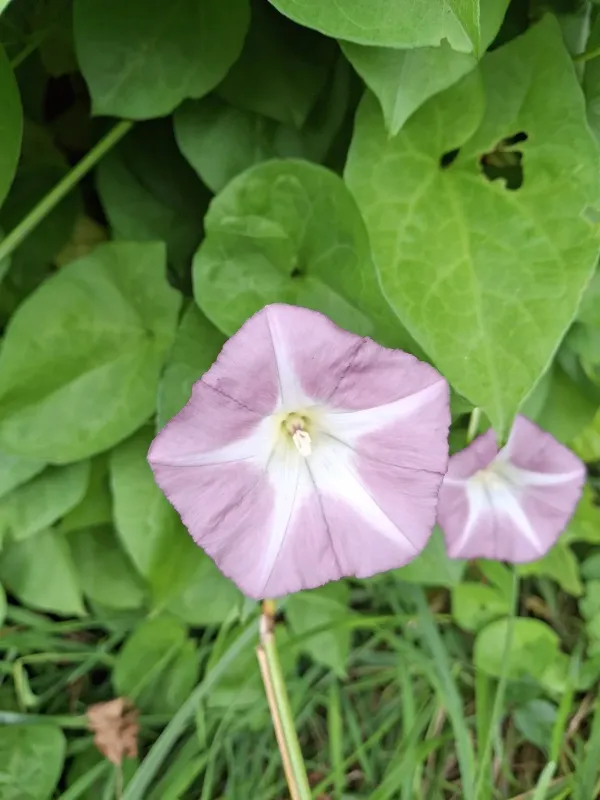
The flowers are large, funnel-shaped, and white, characterized by two large bracts that completely enclose the flower base.
The fruit is a capsule containing dark brown seeds that can remain viable in the soil for several years.
Where it grows
This weed thrives in moist, fertile, and nitrogen-rich soils. It is commonly found in riparian zones, shrubby areas, and along road verges.
In agricultural settings, hedge bindweed infestations frequently occur in cereal fields, row crops, gardens, and orchards, particularly in damp areas.
Harm it causes
The primary damage is the suppression of crop growth. The weed twines around crop stems, causing lodging and making mechanical harvesting difficult.
Bindweed competes intensely for soil moisture and nutrients, starving the desired crops of resources necessary for optimal yield formation.
Dense infestations create a humid microclimate within crop canopies, which significantly increases the risk of fungal disease outbreaks.
The presence of bindweed reduces the photosynthetic efficiency of crops by shading their foliage with its aggressive climbing stems.
Contamination of harvested material with bindweed vines requires additional labor and equipment costs during cleaning and processing.
How to control
Agrotechnical management involves regular deep tillage to disrupt and exhaust the rhizome system. Repeated cutting prevents the storage of nutrients in the roots.
Crop rotation incorporating species that develop a dense canopy is recommended to suppress bindweed germination and growth through effective shading.
Chemical control often relies on systemic herbicides, such as glyphosate, applied during active growth to ensure the chemical reaches the root system.
- Application of systemic herbicides after harvest on regrowth.
- Stubble cultivation to mechanically damage the extensive root networks.
- Monitoring and cleaning of non-cropped areas to prevent spread.
- Use of selective herbicides in accordance with crop-specific regulations.
- Hand removal of rhizomes in small, high-value garden beds.
Reference
Connections · Hedge bindweed
Most often together:
Marketplace
Products · 1
Biology
Taxonomy
- Latin name
- Calystegia sepium
- Family
- Вьюнковые
- EPPO code
- CAGSA