
Low bindweed
Calystegia spithamaea
Description
How to tell it apart
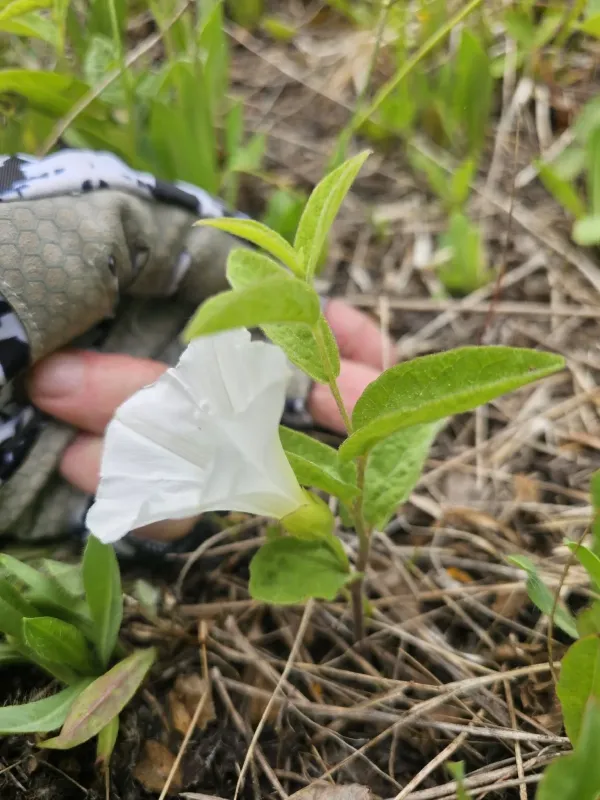
Low bindweed (Calystegia spithamaea) is a perennial herbaceous plant belonging to the Convolvulaceae family. Unlike its vining relatives, this species is characterized by its upright or ascending stems, typically reaching only 15–30 cm in height.
The leaves are alternate, short-petioled, and oval-oblong in shape, with distinct pubescence on the undersides. The plant does not climb; instead, it forms dense, low-growing colonies that can spread across open ground.
The plant produces large, white, funnel-shaped flowers, usually solitary in the leaf axils. Flowering typically occurs from late spring through mid-summer, providing a clear visual marker for identification in the field.
The root system is a robust, spreading rhizome network. This underground structure is the primary reason for the plant's tenacity, as it allows for vegetative propagation and storage of energy reserves throughout the dormant season.
Reproduction occurs both through seeds and, more dominantly, through the fragmentation of its deep rhizomes. Tillage operations that break these roots often exacerbate the spread rather than eliminating the weed.
Where it grows
Low bindweed thrives in open, sunny environments with well-drained, sandy, or gravelly soils. It is frequently found along roadsides, open prairies, forest edges, and fallow agricultural land.
In farming systems, it is a significant nuisance in row crops and perennial pastures. It is particularly competitive in areas where the canopy of the main crop is thin or does not fully close, allowing light to reach the soil surface.
The plant demonstrates high tolerance for drought and nutrient-poor soils, enabling it to establish populations where other weeds might fail. It often colonizes field margins before migrating into the interior of cultivated blocks.
Disturbed soil environments, such as construction sites or improperly managed headlands, act as primary nurseries for the weed. From these points, it can easily infiltrate adjacent crop land during routine cultivation.
Regional distribution is common in temperate climates, where the weed benefits from the distinct seasonal cycle to harden its rhizomes for winter survival.
Harm it causes
The primary impact of low bindweed is its competition for soil moisture and nutrients. Its extensive rhizome network depletes the topsoil, directly reducing the available resources for the primary crop.
Dense clusters of the weed create significant shade for emerging crops, suppressing initial growth and leading to reduced stand density. This early-season interference can cause long-term yield losses.
Low bindweed can host various plant pathogens and insect pests, acting as a green bridge throughout the season. This increases the risk of disease transmission to commercial crops, necessitating frequent pesticide applications.
During harvest, the presence of these weeds complicates mechanical operations. Their tough, fibrous rhizomes and stems can clog harvest machinery, leading to downtime and increased maintenance costs.
Contamination of the harvested product with pieces of the plant increases moisture levels in grain, creating risks for storage spoilage and lowering the overall quality grade of the crop.
How to control
Effective management requires a combination of mechanical and chemical strategies. Deep tillage can help expose and dry out rhizomes, though it must be done carefully to avoid spreading root fragments.
Systemic herbicides, particularly glyphosate-based products, are effective when applied during the active growth phase. The chemical translocates into the rhizomes, providing a higher probability of total plant kill.
Integrated crop management, including the use of competitive cover crops, is essential for long-term control. Shading out the weed limits its photosynthetic capacity and reduces its ability to store energy in the roots.
Maintaining clean field borders is crucial to prevent the initial infestation. Proactive monitoring and spot treatment of emerging patches can stop the weed from becoming a systemic issue across the farm.
- Use of non-selective systemic herbicides.
- Intensive cultivation during fallow periods.
- Crop rotation with high-density species.
- Scouting and patch-level eradication.
- Avoiding deep tilling of infested areas.
Taxonomy
- Latin name
- Calystegia spithamaea
- Family
- Вьюнковые
- EPPO code
- CAGSQ