
Calystegia pellita
Calystegia pellita
Description
How to tell it apart
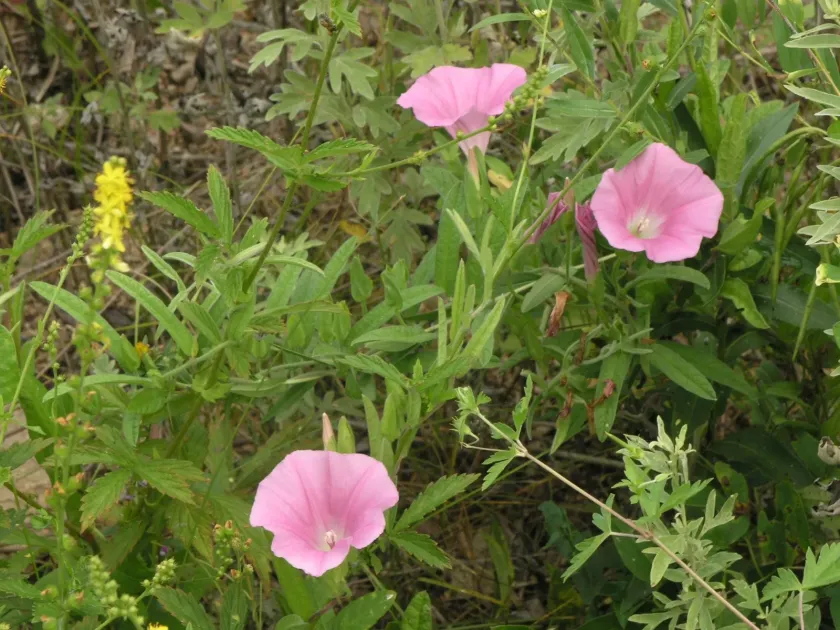
Calystegia pellita is a perennial weed belonging to the Convolvulaceae family. It is distinguished by the dense pubescence (fine hairs) covering its stems and leaves.
The plant grows either erect or slightly twining, reaching heights of up to one meter. Its leaves are typically sagittate or hastate in shape.
During the summer months, it produces large, funnel-shaped flowers that range from white to pale pink, usually appearing in leaf axils.
The plant possesses a deep and extensive network of rhizomes, which serves as the primary mechanism for its aggressive vegetative expansion.
Its identification is confirmed by the visible hairiness of its vegetative organs, which differentiates it from other common bindweed species in the field.
Where it grows
This species is commonly found in moist habitats, such as riverbanks, floodplains, and dense scrublands where soil moisture remains high.
In agricultural settings, it frequently invades row crops, cereals, and permanent grasslands, often encroaching from nearby uncultivated field borders.
The weed thrives in fertile soils and is highly resilient to varying climate conditions due to the substantial energy storage in its root system.
It often establishes itself in areas with poor drainage, where its vigorous growth can easily outperform native vegetation or cultivated crops.
The ability to regenerate from small fragments of rhizomes allows the plant to persist in agricultural lands despite frequent soil disturbances.
Harm it causes
Calystegia pellita causes significant economic loss by competing directly with crops for essential nutrients, water, and sunlight throughout the season.
The twining stems can pull down crop stalks, leading to widespread lodging, which reduces harvest efficiency and results in substantial yield loss.
By forming dense mats of foliage, the weed shades out crop seedlings, preventing them from achieving their full potential during early growth stages.
The rhizomes can become deeply embedded in the soil, making it physically difficult to prepare the land for subsequent plantings.
Furthermore, it acts as a host for various pests and plant viruses, creating a cycle of disease pressure that threatens nearby crop health.
How to control
Mechanical control focuses on depleting the energy stored in the rhizomes through persistent cultivation and cutting of the aerial parts of the plant.
Deep tillage should be employed to expose rhizomes to the sun, causing them to dehydrate and lose their viability before they can re-establish.
- Application of systemic herbicides during the flowering stage.
- Crop rotation featuring competitive, dense-canopy crops.
- Regular monitoring and cleaning of equipment to prevent root spread.
- Maintenance of non-crop areas to limit initial infestation zones.
Chemical control is most successful when systemic herbicides are applied at the peak of vegetative growth or during early flowering to ensure root absorption.
Integrated weed management, combining tillage and chemical intervention, is essential to minimize the impact of this stubborn perennial on farm productivity.
Taxonomy
- Latin name
- Calystegia pellita
- Family
- Вьюнковые
- EPPO code
- CAGPE