
Western bindweed
Calystegia occidentalis
Description
How to tell it apart
Western bindweed (Calystegia occidentalis) is a member of the Convolvulaceae family. It is a perennial herbaceous plant known for its climbing, twining habit.
The plant features long, slender stems that readily entwine around crops, weeds, or fences, climbing vertically to reach sunlight while shading its host.
Leaves are typically arrow-shaped or hastate, contributing to the dense canopy cover that the plant forms when left uncontrolled in a field environment.
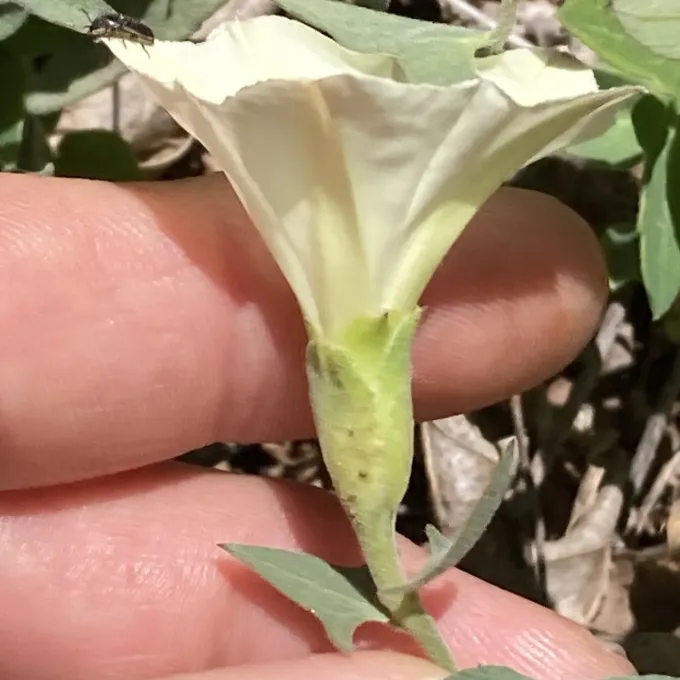
The flowers are trumpet-shaped, white to cream-colored, and bloom from the leaf axils, producing small capsules containing multiple hardy seeds.
Beneath the surface, the plant develops an extensive, deep, and highly regenerative root system, which acts as the primary structure for spreading throughout the field.
Where it grows
Native to western North America, this species thrives in open, sunny habitats including disturbed sites, roadsides, pastures, and agricultural fields.
It prefers well-drained, fertile soils but shows significant resilience to environmental stressors, allowing it to colonize diverse agricultural landscapes.
In farming, it frequently invades cereal grain fields, vineyards, and vegetable crops, where it finds ample support structures for its climbing stems.
The dispersal of this weed occurs both through seeds carried by environmental factors and through the fragmentation of rootstocks during soil tillage.
It often establishes early in the spring, outcompeting emerging crops by monopolizing available moisture and nutrients from the upper soil layers.
Harm it causes
The primary damage caused by Western bindweed is the severe suppression of crop growth through intense competition for light, water, and essential nutrients.
Its twining habit leads to the lodging of grain crops, which significantly complicates mechanized harvesting and results in substantial yield losses.
The dense leaf mats increase humidity around the crop base, creating an ideal environment for the proliferation of fungal pathogens and pests.
By exhausting soil moisture and nutrients, the weed reduces the overall vigor of the primary crop, leading to stunted development and lower quality produce.
Contamination of the harvest with weed plant material and seeds creates additional processing costs and reduces the commercial value of the grain.
How to control
Management requires an integrated strategy that focuses on exhausting the carbohydrate reserves within the underground root system.
Mechanical tillage is effective for disrupting the root network, especially when performed repeatedly during dry conditions to ensure the desiccation of root pieces.
Regular cultivation in row crops helps eliminate the above-ground biomass, preventing the plant from photosynthesizing and refueling its root system.
Chemical control is vital for mature infestations, with systemic herbicides being the most effective tool to ensure translocation to the deep roots.
- Application of glyphosate-based herbicides to regrowth on stubble after harvest.
- Use of selective post-emergence herbicides compatible with specific crop safety labels.
- Utilizing cover crops to suppress weed emergence through intense shading and nutrient competition.
Taxonomy
- Latin name
- Calystegia occidentalis
- Family
- Вьюнковые
- EPPO code
- CAGOC