
Japanese Bindweed
Calystegia hederacea
Description
How to tell it apart
Calystegia hederacea, commonly known as Japanese bindweed, is a persistent perennial vine belonging to the Convolvulaceae family. It is recognized by its climbing habit and rapid growth, often forming dense mats that cover agricultural fields.
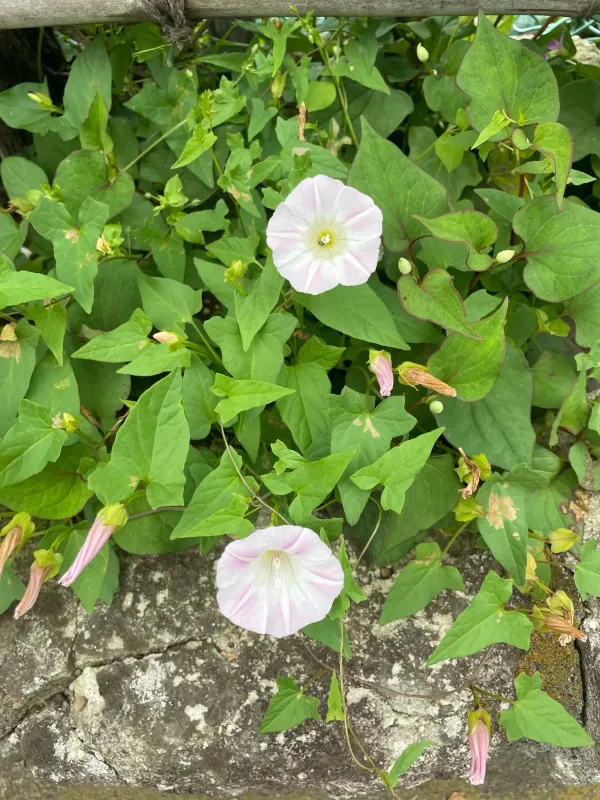
The plant features distinctively arrow-shaped or ivy-shaped leaves and long, slender, twining stems. These stems are highly flexible, allowing them to tightly wrap around the stalks of host crops, causing significant structural interference.
The flowers are trumpet-shaped, typical of the family, and range from white to pinkish shades. They appear solitary in leaf axils during the summer months, blooming continuously from June through September.
Its root system is extensive and aggressive, consisting of deep, creeping rhizomes. These rhizomes store significant energy reserves, allowing the plant to survive harsh winter conditions and quickly resprout in the spring.
Reproduction occurs primarily through vegetative spread via rhizome fragments, though seed production also contributes to its dissemination across cultivated lands, making it a difficult weed to eradicate.
Where it grows
This species thrives in moist, fertile soils and is commonly found in cereal crops, vegetable gardens, and disturbed agricultural sites. It is highly adaptable and can quickly colonize areas with poor weed management.
Harm it causes
Japanese bindweed is notorious for causing crop lodging. By physically wrapping around crop stems, it pulls them down, hindering light absorption and significantly reducing the overall productivity of the field.
The weed acts as a heavy nutrient and water competitor. Its rapid biomass production extracts essential resources from the soil, directly depriving nearby crops and leading to stunted growth and reduced yields.
Its dense foliage creates a microclimate with high humidity levels at the base of crops. This environment is ideal for the proliferation of various fungal pathogens and pests, complicating crop health management.
Harvesting efficiency is severely compromised by the presence of this weed. Twining stems frequently entangle with harvesting machinery, causing mechanical failures, blockages, and significant time losses during critical periods.
The presence of Calystegia hederacea in harvested grain batches reduces quality standards. Processing plants often require extensive cleaning and sorting, which adds labor and operational costs to the farmer.
How to control
Mechanical control involves deep primary tillage to expose rhizomes to desiccation. However, care must be taken during cultivation to avoid fragmenting the roots, as each piece can potentially initiate a new plant.
Chemical control using systemic herbicides, particularly those based on glyphosate, is the most effective approach. Applications should be timed during the plant's active growth phase for maximum translocation into the roots.
In selective cropping systems, specific herbicides targeting broadleaf weeds are utilized to suppress growth. Repeated applications are often necessary to exhaust the root system's energy reserves over multiple seasons.
Implementing a robust crop rotation strategy is essential for suppression. Competitive crops that form a dense canopy can shade out the bindweed and reduce its ability to establish or spread effectively.
Sanitation practices are vital. Cleaning agricultural equipment before moving between fields prevents the accidental transport of rhizome fragments, effectively slowing the spread of this aggressive perennial weed.
Taxonomy
- Latin name
- Calystegia hederacea
- Family
- Вьюнковые
- EPPO code
- CAGHE