
Large bindweed
Calystegia sylvatica
Description
How to tell it apart
Large bindweed (Calystegia sylvatica) is a perennial herbaceous plant belonging to the Convolvulaceae family, categorized as a deep-rooted rhizomatous weed.
The plant features long, twining stems that can reach up to 3 meters, spiraling clockwise around any available support, including crop stalks.
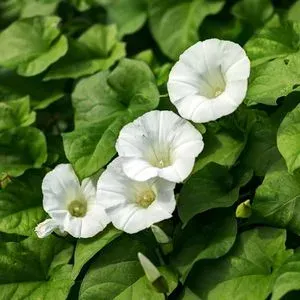
It has distinct arrow-shaped leaves on long petioles, which provide a broad surface area for rapid growth and competition in a variety of environments.
The flowers are large, white, trumpet-shaped, and solitary, growing in leaf axils. They are a primary diagnostic feature of the species during the blooming season.
The root system consists of extensive, fleshy white rhizomes that can penetrate deep into the soil, making it highly resilient and capable of vegetative regrowth.
Where it grows
Large bindweed thrives in fertile, moist soils and is commonly found in riparian zones, forest edges, hedgerows, and neglected rural areas.
In agricultural systems, it aggressively invades cereal crops, row crops, vegetable gardens, and orchards, where it utilizes nutrient-rich soils for rapid expansion.
The weed frequently spreads from field margins, fence lines, and irrigation ditches, quickly colonizing internal sections of cultivated fields.
It prefers well-drained but moist conditions, often exploiting the microclimate provided by dense crop foliage to establish itself effectively.
Its ability to tolerate partial shade allows it to survive in dense agricultural stands, waiting for opportunities to climb and compete for sunlight.
Harm it causes
The primary damage caused by Large bindweed is its aggressive climbing behavior, which pulls down crop stems, causes lodging, and results in significant yield reduction.
It competes heavily with crops for essential soil nutrients and water, reducing the overall vigor and reproductive capacity of the cultivated plants.
By overtopping crops, the bindweed blocks sunlight, severely hindering photosynthesis and delaying the maturation of the crop harvest.
During harvest, the intertwined stems create significant operational challenges, clogging machinery and reducing the efficiency of mechanical harvesting equipment.
Furthermore, the dense vegetative mass maintains high humidity levels around the crop base, which significantly increases the risk of fungal disease outbreaks.
How to control
Mechanical control measures involve deep plowing to bring rhizomes to the surface for desiccation, as well as regular cultivation to deplete root energy reserves.
A consistent management strategy requires repeated removal or cutting of the foliage to prevent the accumulation of nutrients in the underground rhizome network.
Chemical control is most effective when using systemic herbicides that translocate to the roots, typically applied during the active growth phase of the weed.
Cultural control through crop rotation and the use of competitive cover crops can help suppress bindweed by limiting its access to necessary light and space.
- Application of glyphosate-based herbicides in fallow fields.
- Use of selective systemic herbicides in cereal crop stands.
- Frequent shallow inter-row cultivation during the growing season.
- Management of field edges and fence lines to remove initial sources of infection.
- Maintenance of uniform and dense crop stands to naturally suppress seedling growth.
Taxonomy
- Latin name
- Calystegia sylvatica
- Family
- Вьюнковые
- EPPO code
- CAGSI