
Sea bindweed
Calystegia soldanella
Description
How to tell it apart
Sea bindweed (Calystegia soldanella) is a perennial herbaceous plant belonging to the Convolvulaceae family. It is characterized by creeping rhizomes and prostrate stems that often root at the nodes, forming dense mats on the soil surface.
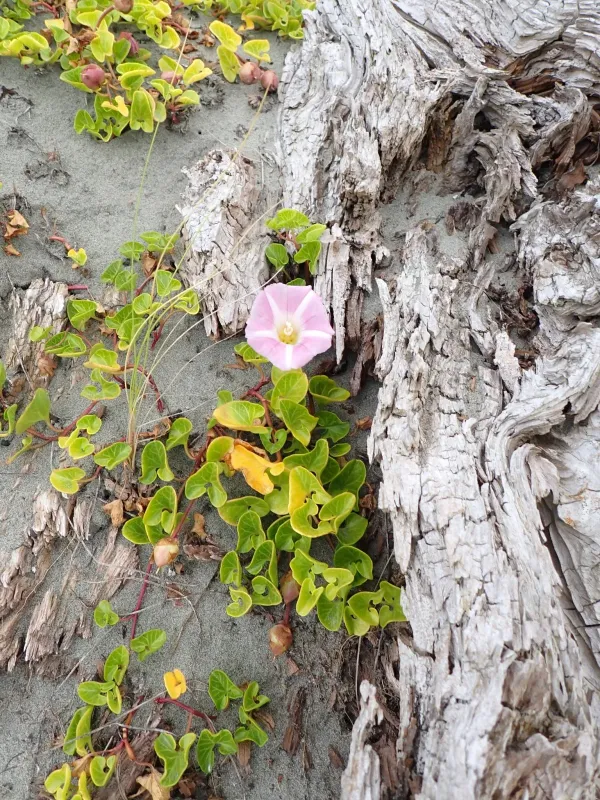
The leaves of this plant are kidney-shaped or rounded, fleshy, and often glossy, which serves as an adaptation to sandy soil conditions. The leaf margins are entire, and the surface is smooth to the touch.
The flowers of the sea bindweed are large and funnel-shaped, usually exhibiting soft pink or white coloration. They are borne on relatively long stalks in the leaf axils, making them highly visible during the flowering season.
The fruit is a rounded capsule containing dark seeds. The plant reproduces through both seed dispersal and vegetative propagation via its robust root system, which significantly increases its survival rate in diverse environments.
Biologically, it is classified as a perennial rhizomatous weed with high phenotypic plasticity. It is capable of thriving in saline soils and can tolerate moisture deficits, making it a persistent weed in coastal and disturbed areas.
Where it grows
The primary habitat of sea bindweed includes coastal dunes, sandy beaches, and maritime environments. The plant is specifically adapted to substrates with high sand content and salt levels where other weed species struggle to establish.
In agricultural practice, sea bindweed can be found in coastal farmlands or fields adjacent to dunes. Infestation typically occurs during the conversion of coastal lands into arable soil or through the movement of soil containing rhizome fragments.
The plant prefers open, well-lit areas. It is rarely found in shaded environments, which is why competition with tall, dense-canopy crops serves as a limiting factor for its widespread development in fields.
Seed dispersal is frequently facilitated by water (hydrochory). Seeds entering irrigation canals or transported via floods to fields can germinate rapidly when conditions are favorable.
Disturbance of the natural vegetation cover in coastal zones promotes rapid colonization by this species. While its expansion into general agroecosystems is often restricted by soil requirements, it remains a difficult weed to eradicate once established.
Harm it causes
The agricultural harm of sea bindweed lies in its rapid vegetative growth, which allows it to outcompete cultural crops during the critical initial stages of development.
Its creeping stems form a dense cover that hampers soil aeration and limits light availability for crop seedlings. This competition leads to thinner crop stands and a significant reduction in overall yield.
The deep-reaching root system allows the weed to compete aggressively for soil moisture and nutrients. In drought-prone regions, sea bindweed acts as a major competitor for resources, stressing the main crop.
The presence of dense weed mats interferes with mechanized agricultural operations. When tillage equipment is used, rhizome fragments are easily spread across the field, leading to further expansion of the infestation.
While primarily a coastal weed, its presence in fields reduces the quality of harvests and complicates the logistics of cultivation. High infestation rates necessitate additional costs for seed cleaning and intensive weed management programs.
How to control
The primary agrotechnical method for controlling sea bindweed is deep plowing with moldboard inversion. This practice exposes the rhizomes to the surface, where they succumb to desiccation or frost during winter.
Regular discing within a semi-fallow soil management system is highly effective. Repeated cutting and disturbance of the root system deplete the plant's carbohydrate reserves, eventually leading to its exhaustion and mortality.
Crop rotation incorporating vigorous, shade-producing crops (such as winter cereals or perennial grasses) is an essential strategy to limit the growth of this light-demanding weed.
For chemical control, the application of glyphosate-based herbicides during the plant's peak growth phase, prior to crop sowing or on post-harvest stubble, is recommended to effectively suppress the rhizome system.
To prevent the spread of sea bindweed, strict sanitation of planting material and the maintenance of clean buffer zones around fields are required. Mechanical isolation of infestation patches prevents the weed from spreading to uncontaminated areas.
Taxonomy
- Latin name
- Calystegia soldanella
- Family
- Вьюнковые
- EPPO code
- CAGSO