
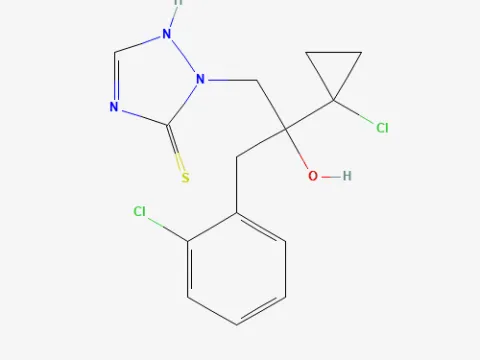
Prothioconazole
Prothioconazole belongs to the triazolinthione chemical class and acts as a systemic fungicide with a broad spectrum of activity. It possesses the ability to penetrate deep into plant tissues, providing both preventive and curative protection.
What the section contains
Prothioconazole
The mechanism of action involves inhibiting the 14-alpha-demethylation process during ergosterol biosynthesis. Ergosterol is a vital component of fungal cell membranes, and without it, fungal growth and reproduction become impossible.
Unlike traditional azoles, prothioconazole demonstrates higher biological efficacy against a wide range of pathogens. Its unique chemical structure allows it to block fungal enzyme systems even in cases where pathogens show resistance to other classes of triazoles.
The active ingredient moves rapidly acropetally through the plant's xylem, which protects not only the treated parts but also new growth. This property ensures a long period of protective action, often lasting up to 3–4 weeks.
Products based on this substance effectively suppress mycelial development, slow down sporulation, and block conidia germination. This makes it an indispensable component in integrated pest management programs against complex fungal infections.
Prothioconazole is a key component for controlling diseases in small grain cereals. It is highly effective against various species of rust, including brown and yellow rust, as well as Fusarium head blight.
In winter wheat and barley, the substance actively suppresses leaf and glume blotch, net blotch, spot blotch, powdery mildew, and rhynchosporium. This helps preserve crop quality and reduces the accumulation of mycotoxins in the grain.
In oilseed rape, prothioconazole leads in controlling Sclerotinia stem rot, phoma leaf spot, Alternaria, and Cylindrosporium. Application during the flowering period significantly reduces the risk of pod infection.
The substance is also successfully used in seed treatment formulations to control smut diseases, as well as root and foot rots in cereals. It promotes the emergence of healthy seedlings even under high disease pressure.
- Fusarium species
- Rust diseases
- Septoria
- Powdery mildew
- Sclerotinia
Application rates for prothioconazole vary depending on the crop, disease severity, and the specific formulation used (it is often combined with tebuconazole or spiroxamine).
For foliar applications on cereals, rates typically range from 100 to 200 grams of active ingredient per hectare. Precise timing is determined by the growth stage, usually from stem elongation to flowering.
When used as a seed treatment, the application rate is significantly lower and is selected based on the phytosanitary condition of the seed lot. Uniform coating is essential to achieve the maximum protective effect.
For rapeseed protection, the most critical window is the active flowering stage, when the risk of white mold development is highest. The optimal application timing is chosen based on weather forecasts and monitoring of pathogen spore levels.
The frequency of application per season is usually limited to two treatments to avoid the development of resistance in pathogens and to stay within acceptable residue limits in marketable grain.
The main precaution involves rotating products with different mechanisms of action. Prolonged use of prothioconazole alone may lead to the selection of resistant fungal populations, so usage in tank mixtures is strongly recommended.
It is essential to strictly follow pre-harvest intervals established for each specific crop. This prevents the presence of residue levels in food products above the regulatory maximums.
Handling the product requires standard safety measures when working with pesticides: the use of protective coveralls, respirators, and gloves. Contamination of water bodies and sewage systems with the spray solution must be avoided.
When preparing tank mixtures, it is important to conduct a physical compatibility test to prevent precipitation or loss of efficacy. Mixing with highly alkaline products is generally not recommended.
Application should ideally occur at temperatures between +12 and +25 degrees Celsius with little to no wind, which ensures optimal absorption of the active ingredient by the plant.