
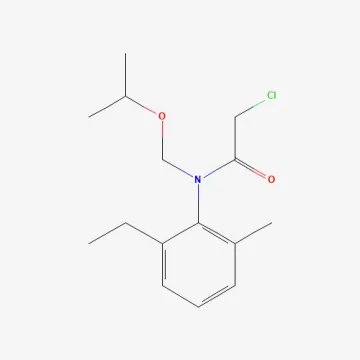
Propisochlor
Description
Mode of action
Propisochlor is a selective herbicide belonging to the chloroacetanilide chemical class. It is primarily used as a pre-emergence treatment to control weeds before they emerge from the soil surface, providing a crucial head start for the crop.
The mode of action involves the inhibition of protein synthesis and cell division within the meristematic tissues of germinating weed seeds. By interfering with these vital biological processes, the herbicide prevents the growth of shoots and roots, leading to the death of weeds.
The compound is absorbed by the roots and shoots of germinating weeds. Its systemic nature ensures that the active ingredient is well-distributed within the weed tissue, providing an effective barrier against infestation throughout the initial growth stages.
Crop selectivity is achieved through the metabolic capacity of crops like corn or sunflowers to detoxify the herbicide. While the target weeds are unable to process the chemical, the tolerant crops remain unaffected, allowing them to establish a healthy root system and canopy without competition.
Environmental conditions play a significant role in the efficacy of propisochlor. Adequate soil moisture is essential for the activation of the chemical, which creates a protective herbicide film in the top layer of the soil where most weed seeds germinate.
What it targets
Propisochlor is designed to control a wide range of annual grass weeds and certain broad-leaved weeds. It is particularly effective against species that commonly infest row crops and compete aggressively for sunlight, water, and soil nutrients.
Target species include common weeds such as barnyard grass, crabgrass, foxtail species, and specific broad-leaved weeds like pigweed. It acts as a powerful preventative tool against seed-propagated weed populations in agricultural fields.
The herbicide is widely registered for use in maize, sunflower, soybean, and oilseed rape cultivation. By eliminating early-season weed pressure, it helps secure optimal yields and simplifies subsequent agronomic management practices.
It is important to note that propisochlor is not effective against established perennial weeds that propagate via rhizomes or deep root systems. It is primarily a preventative agent, not a post-emergence curative herbicide for mature weeds.
Tank mixtures are often employed to broaden the spectrum of controlled weed species. By combining propisochlor with other compatible active ingredients, farmers can achieve more comprehensive control of diverse weed flora in a single application pass.
Rates and timing
Application rates are determined by soil texture and organic matter content. Lighter, sandy soils typically require lower doses, while heavier clay soils with high organic matter require higher rates to ensure the herbicide remains active and effective.
The timing of application is critical: it must be applied before, during, or immediately after planting, but before the emergence of the crop and weeds. Once weed seedlings appear above the surface, the efficacy of the treatment is significantly diminished.
Proper field preparation is necessary for successful application. The soil surface should be finely tilled and free of large clods to ensure uniform distribution of the herbicide spray. Uneven coverage can create gaps that allow weeds to establish themselves.
Farmers should strictly follow the manufacturer's instructions for mixing the spray solution. Using calibrated equipment is vital to ensure an even distribution over the treated area and to prevent overspray into non-target zones.
Post-application disturbance of the soil, such as deep cultivation, should be avoided as it can disrupt the herbicide layer. If inter-row cultivation is necessary, it should be kept shallow to maintain the integrity of the protective soil barrier.
Restrictions
A primary limitation of propisochlor is its lack of post-emergence activity. It cannot be used to control existing weed stands, making timing the most essential element of a successful weed management program using this chemistry.
Safety and handling are paramount. Operators must wear appropriate personal protective equipment (PPE) during application, as the chemical can cause irritation and health risks upon contact with skin, eyes, or through inhalation.
Environmental stewardship is a strict requirement. The product must be kept away from water sources and sensitive aquatic ecosystems, as it can be toxic to aquatic life. Proper disposal of empty containers and leftover solution is required by law.
Weather conditions can affect performance. Excessive rain shortly after application can leach the chemical into deeper soil layers, potentially reducing efficacy or, in rare cases, causing crop stress. Conversely, prolonged drought may prevent the chemical from activating properly.
Storage should be conducted in accordance with the manufacturer's guidelines, maintaining appropriate temperatures and ensuring that the chemical is kept in its original, sealed container in a secure, well-ventilated area away from food and feed.
Status in the European Union
Not approved in the EU
- CAS number
- 86763-47-5
- ADI
- 0.025 mg/kg bw/day
- ARfD
- 0.05 mg/kg bw
- AOEL
- 0.025 mg/kg bw/day
EU status is for reference only and does not replace national registration in your country.