
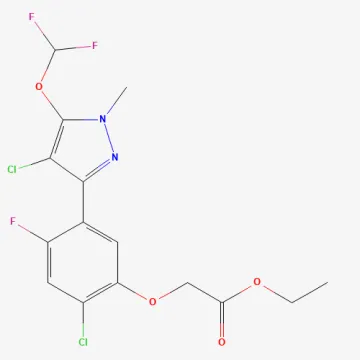
Pyraflufen-ethyl
Description
Mode of action
Pyraflufen-ethyl belongs to the phenylpyrazole chemical class and serves as a highly active contact herbicide. Its primary mechanism involves inhibiting the protoporphyrinogen oxidase (PPO) enzyme found within the chloroplasts of green plants.
By blocking this enzyme, the plant experiences an accumulation of metabolic intermediates that are highly reactive. Upon exposure to sunlight, these intermediates cause a rapid rupture of plant cell membranes, leading to severe cellular damage and immediate tissue necrosis.
The visual impact of the herbicide is remarkably fast; treated weeds often show symptoms of desiccation within hours of application. As a contact-only product, it impacts strictly the tissues that come into direct contact with the spray solution.
Since the active ingredient does not translocate significantly within the plant's vascular system, it does not provide systemic control. However, this characteristic makes it an excellent choice for rapid top-kill of weeds or for desiccation purposes before harvest.
The efficiency of the herbicide is heavily dependent on sunlight, as the process of photo-oxidation required to destroy the plant cells is light-driven. Application during cloudy days may reduce the speed of the effect.
What it targets
Pyraflufen-ethyl is effective against a broad spectrum of broad-leaved weeds. It targets problematic species such as common lambsquarters, knotweed, pigweed, and black nightshade, often controlling weeds that have developed resistance to other chemical classes.
It is used across various crops, including cereals, corn, soybeans, potatoes, and vineyards. Beyond its role as a herbicide, it is widely utilized as a crop desiccant to facilitate timely harvesting by drying out both the crop canopy and any green weed cover.
This substance is invaluable for managing weeds that have overgrown the stage at which systemic herbicides are typically effective. It quickly halts nutrient and moisture competition, providing immediate relief to the crop.
While highly effective on broadleaf species, its action on grasses is limited. Therefore, it is often combined with specific graminicides in tank mixes to achieve a broad-spectrum control program tailored to the needs of the agricultural field.
In no-till or reduced-tillage systems, it is used for pre-plant burn-down applications, effectively cleaning the seedbed without leaving persistent residues in the soil profile.
Rates and timing
Typical application rates range from 10 to 30 grams of active ingredient per hectare, depending on the weed species, growth stage, and the intended outcome—whether it is early-season weed control or pre-harvest desiccation.
Success requires thorough coverage of the target foliage. Utilizing high-quality nozzles that produce a fine mist helps ensure that the active substance reaches all leaf surfaces, maximizing the rapid necrotic effect.
Optimal timing for weed control occurs during the active growth phase of the weeds. For desiccation, the timing is dictated by the physiological maturity of the crop to ensure that the process does not compromise yield or quality parameters.
A spray volume of 200–300 liters per hectare is standard, though this can be adjusted based on the density of the canopy. The addition of surfactants can further enhance the retention and uptake of the herbicide on the foliage.
Users should calibrate equipment carefully to ensure uniform distribution, as spotty application can lead to inconsistent results and weed regrowth in untreated zones.
Restrictions
Pyraflufen-ethyl offers an excellent environmental profile due to its low soil persistence. It degrades rapidly in the environment, preventing potential issues with crop rotation and keeping the soil ecosystem relatively stable after application.
Safety is paramount; operators must wear appropriate personal protective equipment, including gloves and face protection, during handling and application to avoid contact with skin, eyes, or inhalation of the spray mist.
Drift management is essential. Due to its high activity, even small amounts of drift onto neighboring sensitive crops can cause severe phytotoxicity. Applications should be avoided during high wind conditions.
Compatibility testing is highly recommended before mixing with other fertilizers or pesticides. Some products may interfere with the physical stability of the tank mix or reduce the efficacy of the herbicide's contact mechanism.
- Do not apply at temperatures exceeding 25°C.
- Avoid application if rain is expected within 2-3 hours.
- Store in a secure, cool, and dry place, away from reach of children.
Status in the European Union
Approved in the EU
- CAS number
- 129630-19-9
- Approved from
- 01.04.2016
- Approval until
- 31.03.2031
- ADI
- 0.2 mg/kg bw/day
- ARfD
- 0.2 mg/kg bw
- AOEL
- 0.1 mg/kg bw/day
EU status is for reference only and does not replace national registration in your country.