
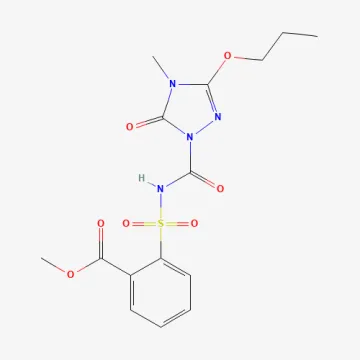
Propoxycarbazone-sodium
Description
Mode of action
Propoxycarbazone-sodium belongs to the chemical class of sulfonylaminocarbonyltriazolinones. It acts as a highly selective herbicide designed to control annual grass weeds and certain broadleaf weeds in cereal crops.
The mode of action involves the inhibition of the acetolactate synthase (ALS) enzyme in target plants. By blocking this essential enzyme, the herbicide effectively halts the biosynthesis of branched-chain amino acids, such as valine and isoleucine.
This metabolic disruption prevents plant cells from dividing and growing, leading to chlorosis and the eventual death of sensitive weed species. The herbicide provides both foliar and residual soil activity.
Selectivity is achieved through the crop's ability to rapidly metabolize the compound into non-toxic substances. Wheat, in particular, exhibits a high tolerance due to this efficient metabolic pathway.
The substance is absorbed through both leaves and roots. Once taken up, it translocates throughout the plant via the phloem and xylem, ensuring systemic impact on the plant's growing points.
What it targets
The primary use of Propoxycarbazone-sodium is for the management of difficult-to-control grass weeds, particularly species such as downy brome and rye brome.
The herbicide is highly effective against common windgrass (Apera spica-venti), which is a major competitor in winter grain production systems across various climates.
In addition to grasses, it provides suppression of several broadleaf species, often including members of the Brassicaceae family such as flixweed and field pennycress.
It is primarily applied in wheat crops, providing a clean field environment that minimizes resource competition and promotes optimal grain yield and quality.
Effective control is achieved when the herbicide is applied during the early vegetative stages of weed development, ensuring that competing plants do not establish dominance over the crop.
Rates and timing
Application rates are determined by weed pressure, weed species composition, and the specific growth stage of the wheat crop. Typically, applications are made during the tillering phase.
Timely application is crucial; once weeds exceed their early growth stages, their sensitivity to the herbicide decreases significantly, potentially reducing the overall efficacy of the treatment.
Environmental conditions play a vital role in efficacy. Ideally, the herbicide should be applied when plants are actively growing and not under environmental stress, such as drought or extreme temperatures.
When preparing tank mixes, it is essential to check compatibility with other pesticides. Avoiding specific organophosphate insecticides is recommended to prevent potential crop injury or antagonism.
Standard application volumes range from 200 to 300 liters of water per hectare, ensuring thorough coverage of the leaf canopy for maximum absorption.
Restrictions
Crop rotation planning is necessary as residues may persist in the soil depending on environmental factors and soil type, which could potentially impact sensitive follow-on crops.
Applications on soils with extremely high or low pH levels should be carefully assessed, as soil chemistry significantly influences the degradation rate and residual life of the compound.
To mitigate the development of herbicide-resistant weed populations, growers should alternate the use of Propoxycarbazone-sodium with herbicides having different mechanisms of action.
Personal Protective Equipment (PPE) is mandatory during the mixing, loading, and application processes to minimize dermal and respiratory exposure to the concentrate.
Strict adherence to buffer zones and wind speed limits during spraying is required to prevent drift onto sensitive non-target areas or adjacent water bodies.
Status in the European Union
Approved in the EU
- CAS number
- 145026-81-9
- Approved from
- 01.09.2017
- Approval until
- 31.08.2032
- ADI
- 0.4 mg/kg bw/day
- ARfD
- Not appl.
- AOEL
- 0.3 mg/kg bw/day
EU status is for reference only and does not replace national registration in your country.