

Reference · Active ingredients
Fungicides
Fungicides are a large group of chemical or biological compounds designed to suppress the growth and development of pathogenic fungi that cause infectious diseases in plants. Depending on their chemical composition, they are classified into organic and inorganic preparations, each of which has a specific impact vector on the physiological processes of the fungal organism.
241
items
What the section contains
 Quinoxyfen
3 products
Quinoxyfen
3 products
 Carbosulfan
Карбаматы
2 products
Carbosulfan
Карбаматы
2 products
 Dimoxystrobin
Стробилурины
2 products
Dimoxystrobin
Стробилурины
2 products
 Oxadixyl
2 products
Oxadixyl
2 products
 Penthiopyrad
2 products
Polyhexamethylene guanidine hydrochloride
2 products
Penthiopyrad
2 products
Polyhexamethylene guanidine hydrochloride
2 products
 Prosulfocarb
Тиокарбаматы
2 products
Prosulfocarb
Тиокарбаматы
2 products
 Benalaxyl-M
Производные аминокислот. Фениламиды
1 product
Benalaxyl-M
Производные аминокислот. Фениламиды
1 product
 Benzovindiflupyr
1 product
Benzovindiflupyr
1 product
 Dichlofluanid
1 product
Dichlofluanid
1 product
 Diniconazole-M
Триазолы
1 product
Diniconazole-M
Триазолы
1 product
 Fenarimol
Пиримидинами
1 product
Fenarimol
Пиримидинами
1 product
 Fluopicolide
Производные аминокислот. Фениламиды
1 product
Fluopicolide
Производные аминокислот. Фениламиды
1 product
 Flutolanil
1 product
Flutolanil
1 product
 Formaldehyde
1 product
Formaldehyde
1 product
 Pyrimethanil
Пиримидинами
1 product
Pyrimethanil
Пиримидинами
1 product
 2-(thiocyanomethylthio)benzothiazole
 2-Phenylphenol
 2,5-Dichlorobenzoic acid methyl ester
 5-chloro-3-methyl-4-nitro-1H-pyrazole
 Aldimorph
 Ammonium hydroxide
 Ampropylfos
Aspergillus flavus strain MUCL 54911
Ampropylfos
Aspergillus flavus strain MUCL 54911
 Azoxystrobin
Стробилурины
Bacillus amyloliquefaciens strain AT-332
Bacillus licheniformis strain FMCH001
Bacillus nakamurai F727
Bacillus subtilis strain FMCH002
Bacillus subtilis strain RTI477
Bacillus velezensis strain RTI301
Barium polysulphide
Azoxystrobin
Стробилурины
Bacillus amyloliquefaciens strain AT-332
Bacillus licheniformis strain FMCH001
Bacillus nakamurai F727
Bacillus subtilis strain FMCH002
Bacillus subtilis strain RTI477
Bacillus velezensis strain RTI301
Barium polysulphide
 Benodanil
 Bentaluron
 Benthiavalicarb
 Bis(tributyltin) oxide
 Bitertanol
 Bixafen
 Blasticidin-S
Brandol
Blasticidin-S
Brandol
 Bronopol
 Calcium propionate
 Carpropamid
 Chlobenthiazone
 Chlorine dioxide
 Chloroneb
 Chlorothalonil
 Chlozolinate
Choline hydrogen phosphonate
Chlozolinate
Choline hydrogen phosphonate
 Cinnamaldehyde
Cresylic acid
Cufraneb
Cinnamaldehyde
Cresylic acid
Cufraneb
 Cyproconazole
 Cyprofuram
 D-tagatose
 Dichlone
 Dichlorophen
 Diclobutrazol
 Dicloran
 Didecyldimethylammonium chloride
Marketplace
Products in this section · 12


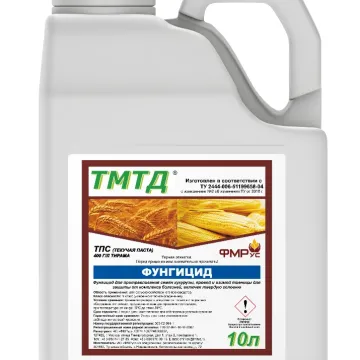


Fungicides
The mechanism of action of fungicides is divided into contact and systemic. Contact preparations form a protective barrier on the plant surface, destroying pathogen spores upon direct contact, but they do not penetrate the tissues. Systemic fungicides are capable of penetrating the plant's vascular system, spreading throughout the organism, which ensures protection not only for existing organs but also for newly formed shoots.
Biochemically, fungicides affect the vital functions of pathogens: they inhibit respiration processes in fungal mitochondria, disrupt the biosynthesis of ergosterol in cell membranes, or block cell division. Many modern preparations possess translaminar activity, allowing the active ingredient to move from one side of the leaf to the other.
The effectiveness of using these substances largely depends on the preparation's ability to maintain stability in field conditions under the influence of ultraviolet light and precipitation. To prevent the formation of resistance in disease pathogens, agronomists recommend alternating fungicides from different chemical classes, which is critical in intensive protection schemes.
In addition to directly destroying fungal spores, some systemic fungicides have an additional curative effect, stopping mycelium development in the early stages of symptom manifestation. This allows for the salvation of crops even in the event of an epiphytotic outbreak, provided that the disease diagnosis is conducted in a timely manner.
This group of preparations is used to combat a wide spectrum of pathogens that cause such dangerous diseases as powdery mildew, cereal rust, late blight of nightshades, gray mold, and various types of leaf spots. Fungicides are effective against ascomycetes, basidiomycetes, and oomycetes that affect field, horticultural, and vegetable crops.
Fungicide application rates are calculated based on the degree of crop infestation, the biological characteristics of the crop, and its growth stage. Minimum dosages are used for preventive treatments, while for curative measures, the dose of the preparation is increased to achieve the necessary concentration of the active ingredient in plant tissues.
The application of fungicides requires strict adherence to safety measures and pre-harvest intervals (PHI). It is necessary to account for the timing of the last application before harvest to ensure the absence of pesticide residues in market produce. Handling chemicals must be performed using personal protective equipment to exclude toxic effects on personnel.