
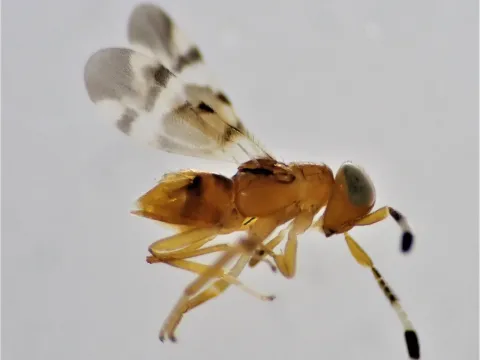
Microterys
Microterys
Microterys is a genus of parasitic wasps belonging to the family Encyrtidae (order Hymenoptera). It is not a plant pest; rather, it is a highly specialized beneficial insect that plays a crucial role in natural pest management.
What the section contains
Microterys
The adult wasps are tiny, typically measuring 1 to 2 mm in length. Their bodies often exhibit a metallic luster, with colors ranging from brownish-yellow to dark brown or black.
They are frequently found moving actively across the bark of trees and shrubs, using their antennae to search for their hosts, which are various species of scale insects.
Their life cycle is intricately linked to that of their hosts. The female wasp deposits eggs inside the scale insect, where the larvae develop, eventually killing the host before emerging as adults.
The presence of Microterys in an agricultural setting is a sign of a healthy, biodiverse environment and successful biological control efforts.
Microterys does not cause damage to agricultural or ornamental plants. Labeling it as a pest is a common misunderstanding that ignores its status as a beneficial parasitoid.
The larvae of Microterys specifically target and consume harmful soft scales, such as the brown soft scale, which can significantly weaken trees and reduce crop yields.
By parasitizing these insects, Microterys acts as a natural regulator, preventing outbreaks of scale insects that would otherwise require extensive chemical intervention.
The impact of this wasp is almost entirely positive, as it keeps populations of sap-sucking pests in check, thereby reducing the stress on the host plants.
Farmers and gardeners benefit significantly from the presence of this wasp, as it performs the work of pest suppression without any negative side effects on the vegetation.
The most visible indicator of Microterys activity is the presence of empty scale insect shells on the twigs or leaves, each featuring a distinct, clean, round exit hole.
These exit holes represent the point where the mature adult wasp has emerged from the host after completing its development inside the scale.
During the spring and summer months, one might spot the small, active wasps walking across leaves or bark, often attracted to the honeydew produced by other insects.
A notable reduction in the population of living, healthy scale insects on infested trees is a primary sign that Microterys is successfully colonizing the area.
Consistent observation of the tree bark can reveal the wasps during their egg-laying phase, providing proof of active biological control in the immediate vicinity.
To support and preserve Microterys populations, it is vital to avoid the prophylactic use of broad-spectrum insecticides that can wipe out beneficial wasp species.
Implementing an Integrated Pest Management (IPM) strategy is the best way to leverage the presence of these wasps for long-term scale insect suppression.
Providing flowering plants nearby acts as a nectar source, which significantly enhances the longevity and reproductive capacity of the adult wasps.
In cases where pest pressure is extremely high, select target-specific insecticides that are known to be safe or have minimal toxicity toward parasitoid wasps.
Cultivating a diverse landscape and maintaining overall tree health helps provide a stable environment for Microterys to thrive and continue its beneficial work.