
Microterys clavellatus
Microterys clavellatus
Description
How to identify
Microterys clavellatus belongs to the Hymenoptera order and the Encyrtidae family. These tiny wasps are primarily known for their role as parasitoids within the ecological communities of scale insects.
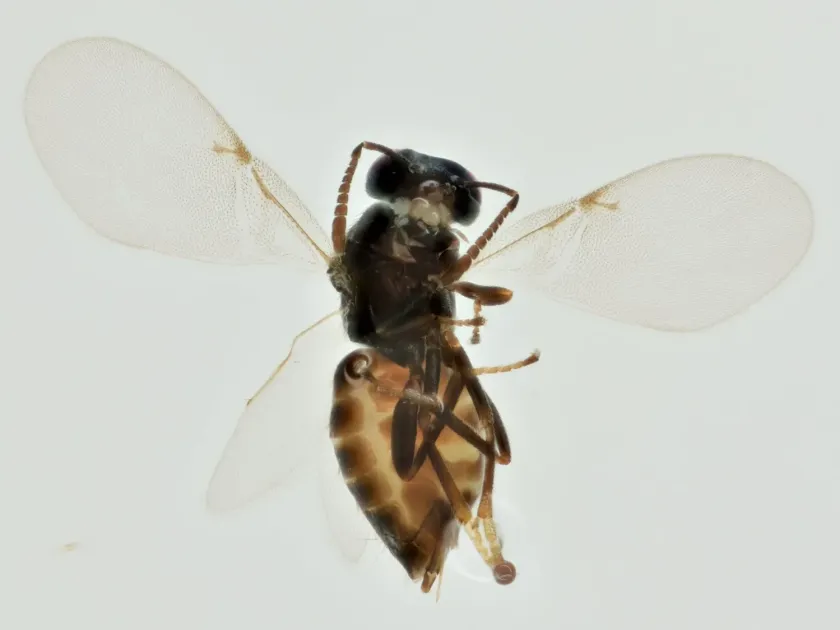
Physically, the adult wasps are characterized by distinct antennae and specialized body structures typical of encyrtid parasitoids. Identification is usually conducted under laboratory conditions using specific taxonomic keys.
The biological nature of this species is tied to its interaction with host populations. While they are often viewed as biological control agents, their presence can sometimes be detrimental if they affect beneficial insect populations.
The life cycle involves the female laying eggs inside the body of a host scale insect. The larva completes its development inside the host, utilizing its internal tissues as a primary food source.
Monitoring for their presence involves collecting infected host specimens from branches and observing the emergence of adults through minute exit holes under high-power magnification.
What it damages
This species primarily targets various soft scale insects (family Coccidae) found on woody plants and trees. Damage is largely determined by the impact these scales have on the host plant health.
In garden ecosystems, the parasitoid's activity might disrupt the natural balance. If the target scales were being controlled by other beneficial insects, the parasitism of those beneficial species by Microterys could lead to secondary pest outbreaks.
Visible damage to the plant is usually the result of the host scale insect's feeding activities. The parasitoid's impact is technically a reduction in the host scale population density.
Economic damage assessment is complex, as it fluctuates between the parasitoid being a helper in pest control and a competitor with other beneficial agents.
Continued monitoring is essential to distinguish between natural population cycles of scales and the suppressive impact of parasitoids like Microterys clavellatus.
When it appears
Activity of adult wasps generally aligns with the warmer seasons, starting in late spring when the overwintering generation emerges.
The species may produce multiple generations per year, depending on the climatic conditions and the availability of suitable host stages throughout the growing season.
Peak emergence typically occurs during stable, warm weather, which facilitates the mating and host-searching behavior of the adult wasps.
Overwintering usually takes place at the larval stage within the host's body, providing a protected environment against winter cold and humidity.
Field surveys for adult activity are most effective from late April through August, utilizing yellow sticky traps or branch sampling methods.
Signs of infestation
The most definitive sign of infestation is the appearance of small, perfectly round exit holes on the bodies of dead or paralyzed scale insects attached to twigs.
Affected scale colonies often show signs of premature senescence, becoming shriveled, discolored, and more fragile than healthy scale insects.
Microscopic examination of host scales often reveals the presence of the parasitoid's puparium or larval remains occupying the hollowed-out internal cavity.
A noticeable decline in the density of active, feeding scale nymphs during the season may suggest high levels of parasitism within the colony.
Lack of new honeydew production on infested branches, despite the presence of scale covers, is another indication that the host population is being compromised.
Control measures
Integrated Pest Management (IPM) is the recommended approach to handle populations of these parasitoids while keeping scale pests under control.
Avoid the use of broad-spectrum insecticides during periods of peak adult wasp activity to allow the natural biological control system to function effectively.
Cultural control measures, such as pruning heavily infested branches, help manage host populations while minimizing the need for heavy chemical intervention.
- Regular monitoring of host scale populations.
- Strategic pruning of heavily infested plant parts.
- Selective use of narrow-range, low-toxicity pesticides.
- Preservation of natural habitats for beneficial insects.
If population levels of scales rise above the economic threshold, consult with a plant protection expert to evaluate whether chemical or biological intervention is required.
Taxonomy
- Latin name
- Microterys clavellatus
- Order
- Hymenoptera
- Family
- Encyrtidae
- EPPO code
- MIROCA
Discussion
No discussions yet — be the first.