

Pest · Coleoptera (beetles) · affects Fodder beet, Wild cabbage, Winter wheat
Especially harmful
Beet midge
Atomaria linearis
Description
How to identify
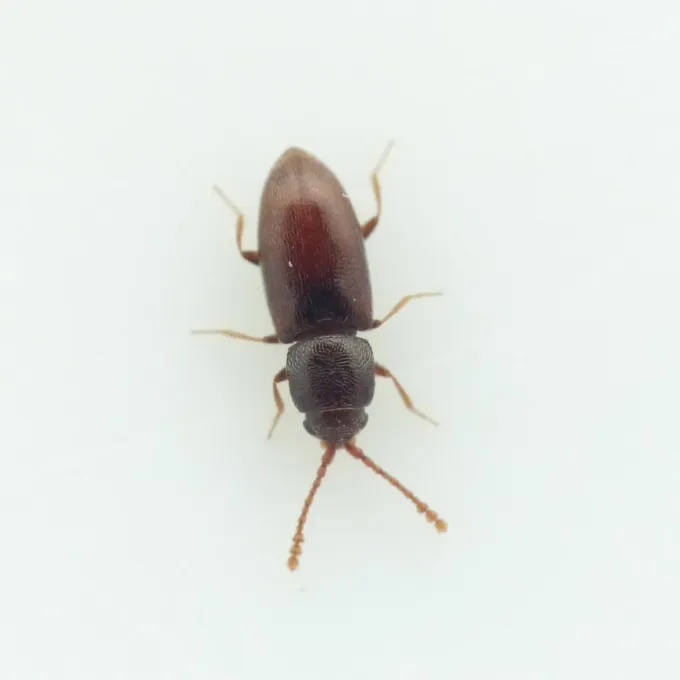
The beet midge (Atomaria linearis) is a small beetle belonging to the order Coleoptera and the family Cryptophagidae. It is characterized by a tiny, elongated body, measuring approximately 1.2 to 1.7 mm in length, with a coloration ranging from brown to black.
The body surface is covered with fine setae (hairs), giving the insect a matte appearance. The antennae are club-shaped, which serves as a definitive diagnostic feature for field identification by agronomists.
Larvae are worm-like, measuring about 2 mm in length. They are pale in color with a dark head and three pairs of small thoracic legs, facilitating their movement within the upper soil horizons where they feed.
Adults overwinter in the soil or under plant debris. They emerge in early spring when soil temperatures reach about 5°C. Their lifespan and development are heavily influenced by ambient temperature and soil moisture levels.
A single female can lay up to 200 eggs in the soil near the roots of host plants. The life cycle from egg to adult takes approximately 40 to 60 days, depending on environmental conditions during the growing season.
What it damages
The primary host for Atomaria linearis is the beet (sugar, fodder, and garden varieties). The beetle is most destructive during the germination phase and the emergence of the first true leaves.
Beyond beets, this pest can feed on a variety of other crops, including oilseed rape, cabbage, hemp, soybean, winter barley, apple trees, and alfalfa. This polyphagous nature makes it a persistent threat in diverse agricultural landscapes.
Both adults and larvae inflict damage, but the primary economic impact is caused by adults feeding on the hypocotyl and cotyledons of emerging seedlings. This often leads to severe stand reduction or total crop loss.
In dry spring conditions, the damage is typically more severe. Weakened seedlings are highly susceptible to secondary infections, such as root rot, which further exacerbates yield losses across the field.
The economic injury level (EIL) is generally reached when 1–2 beetles are observed per linear meter of the crop row during the vulnerable emergence phase of sugar beet development.
Signs of infestation
The most common sign of infestation is the presence of small, irregular pits or shallow furrows on the surface of the hypocotyl, often located near the soil line where the beetle feeds.
Cotyledon leaves may show small, irregularly shaped holes or signs of tissue grazing along the margins. These symptoms indicate early feeding activity that can stunt the plant's growth significantly.
Mass emergence failure or visible thinning of the crop rows is a hallmark of severe infestation. Seedlings may appear wilted or collapsed, and in extreme cases, they fail to establish entirely.
If you suspect an infestation, gently sifting the top centimeter of soil around the base of damaged plants can reveal the presence of the small, dark-colored beetles.
Affected seedlings demonstrate delayed development and stunted growth. Such patches in a field are often colonization epicenters where the pest density is significantly higher than in surrounding areas.
Control measures
Crop rotation is the first line of defense. Avoid planting beets after other beet crops or adjacent to fields that previously supported high populations of host crops like oilseed rape or cabbage.
Mechanical control, such as thorough autumn tillage, is essential. It disrupts the overwintering sites of the beetles and significantly reduces the initial pest pressure for the following spring.
Optimizing sowing dates to ensure rapid and uniform germination is critical. A fast transition through the sensitive seedling stage limits the window of opportunity for the beetles to cause irreparable damage.
Seed treatment with systemic insecticides is the most effective proactive measure. This provides continuous protection to the seedling during the period when it is most vulnerable to midge feeding.
In cases where the pest threshold is exceeded, foliar insecticide applications may be necessary. Using contact or systemic insecticides in the early morning or evening is recommended to maximize efficacy.
In brief
19
Damages crops
Content graph
Damages crops · 19
Content graph
Connections · Beet midge
Most often together:
Marketplace
Products · 8


Dragun
Nanjing No.1 Pesticide Factory of Red Sun Group Co., Ltd.
Insecticides
0
1
·
2.3K
No offers
—
Details

Biology
Taxonomy
- Latin name
- Atomaria linearis
- Order
- Coleoptera (beetles)
- Family
- Cryptophagidae
- EPPO code
- ATOMLI
Community
Discussion
No discussions yet — be the first.