

Two-spotted spider mite
Tetranychus urticae
Description
How to identify
The two-spotted spider mite (Tetranychus urticae) is a significant pest of the Arachnida class, belonging to the family Tetranychidae.
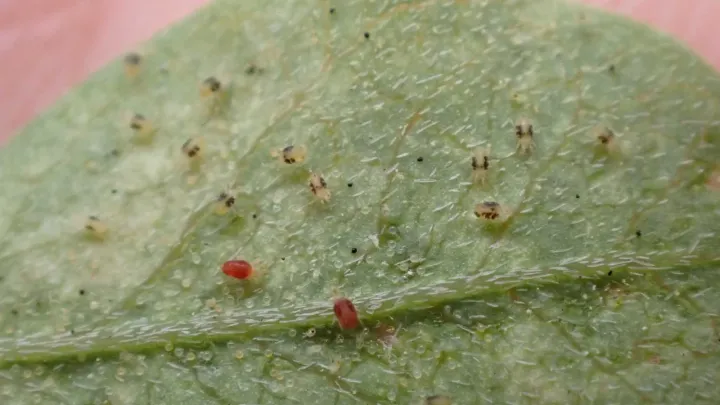
Adult mites are extremely small, measuring roughly 0.4–0.6 mm in length. They are characterized by a greenish or yellowish body with two distinct dark spots on the sides.
The lifecycle includes egg, larva, protonymph, deutonymph, and adult stages. Under optimal conditions, the life cycle is completed in as little as one week.
These mites live in colonies primarily on the undersides of leaves, where they spin intricate silk webs that protect them from predators and environmental stress.
Due to their short generation time and high fecundity, these mites can build massive populations in a very short period, causing severe crop damage.
What it damages
Tetranychus urticae is an extremely polyphagous species that infests numerous agricultural crops, including cucumber, soy, and oilseed rape.
In orchards, it poses a major threat to apple trees, causing physiological stress, chlorosis, and potential yield losses in the following seasons.
Other economically important hosts include fodder beet, hop, cabbage, and winter barley, all of which can suffer significant growth retardation.
The mite feeds by piercing plant cells and extracting the contents, which destroys chloroplasts and disrupts the plant’s normal physiological functions.
Heavy infestations lead to leaf senescence, reduced plant vigor, and in extreme cases, total plant death, particularly under drought-stressed conditions.
When it appears
Mite activity typically resumes in spring once temperatures exceed +12°C. They thrive in warm, dry weather, with peak activity between +25°C and +30°C.
In greenhouse production, the two-spotted spider mite remains active throughout the year, requiring consistent vigilance and integrated management.
Field populations usually surge during the mid-to-late summer months, as high temperatures accelerate their reproductive rates significantly.
The overwintering stage consists of fertilized females, which find shelter in soil debris, leaf litter, or crevices in agricultural structures.
Upon the onset of favorable spring conditions, these females migrate to nearby weeds to start the first generation before moving to susceptible crop fields.
Signs of infestation
The first symptoms are small, yellow, stippled spots on the upper leaf surface, resulting from the destruction of individual plant cells during feeding.
As the infestation progresses, fine, silky webbing becomes visible on the underside of the leaves, where mites congregate and lay their eggs.
Leaves affected by mites eventually lose their green color, turning pale, mottled, or necrotic, eventually leading to premature leaf drop.
Severe infestations can cover the entire plant in webbing, hindering normal growth and potentially covering fruits and flowers in heavy silk deposits.
Stunted growth and reduced sugar content in crops are common secondary indicators that a field is suffering from a prolonged spider mite attack.
Control measures
Successful management of spider mites relies on an Integrated Pest Management (IPM) approach that combines cultural, biological, and chemical methods.
- Maintaining optimal soil and air moisture to create an environment less favorable for mite proliferation.
- Rotation of acaricides with different modes of action to prevent the development of pesticide resistance.
- Utilization of biological control agents, particularly predatory mites such as Phytoseiulus persimilis.
- Stringent weed management around fields to reduce early-season population reservoirs.
- Thorough cleanup of crop residues and sanitation of greenhouse facilities after the harvest to remove overwintering sites.
In brief
24
Damages crops
Content graph
Damages crops · 24
Content graph
Connections · Two-spotted spider mite
Most often together:
Marketplace
Products · 178


Biology
Taxonomy
- Latin name
- Tetranychus urticae
- Order
- Mites
- Family
- Tetranychidae
- EPPO code
- TETRUR
Community
Discussion
No discussions yet — be the first.