

Spider mite
Tetranychus
Description
How to identify
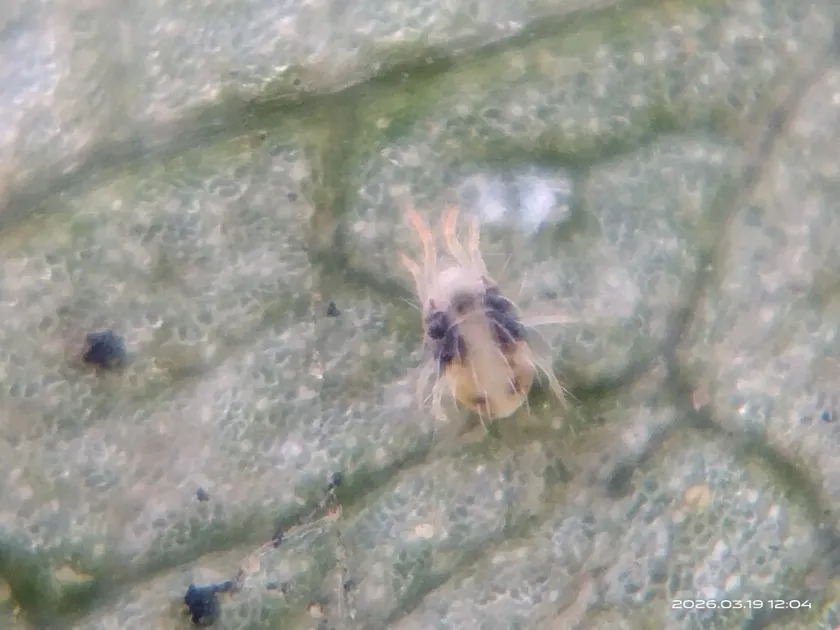
The spider mite (family Tetranychidae) is a minute arthropod, measuring approximately 0.5 mm in length. These pests are often difficult to spot with the naked eye, appearing as tiny moving dots on the undersides of leaves.
Their life cycle includes the egg, larva, two nymph stages, and the adult stage. In hot and arid conditions, the entire life cycle can be completed in as little as one week, leading to rapid population explosions.
Adult females are prolific breeders, capable of laying dozens of eggs during their lifespan. They hibernate in soil, plant debris, or protected areas, emerging when temperatures rise in the spring to begin a new cycle.
Dispersal occurs mainly through wind currents, which carry the mites to new plants. They can also be spread by human activity, contaminated equipment, or nursery stock, making them highly efficient colonizers of new environments.
Spider mites thrive in warm, dry weather. High humidity is generally unfavorable for their development, which is why they are often more problematic in greenhouses or during droughts in agricultural fields.
What it damages
Spider mites are polyphagous pests, known to attack a vast range of crops, including soybeans, cotton, fruits, vegetables, and ornamental plants. Their ability to adapt to different hosts makes them significant threats worldwide.
Feeding involves piercing plant cells and extracting the sap, which leads to chlorosis—a yellowing or stippling of the leaf surface. This activity disrupts photosynthesis and significantly weakens the plant's metabolic functions.
The presence of fine webbing is a classic sign of an established infestation. This webbing provides protection for the colony and can eventually cover large parts of the plant, capturing dust and plant debris.
Severe infestations result in leaf drop, stunted plant growth, and a reduction in crop yield. In extreme cases, the entire plant may collapse and die due to the loss of water and nutrients caused by extensive feeding.
Quality reduction is a major concern, as the unsightly damage caused by mite feeding lowers the market value of fresh produce. Fruits and flowers are often rendered unsellable due to disfigurement and premature senescence.
Control measures
Integrated Pest Management (IPM) is the most effective approach. This includes maintaining optimal plant health through irrigation and fertilization, as stressed plants are more susceptible to mite colonization.
Biological control agents, such as predatory mites like *Phytoseiulus persimilis* or predatory insects, are highly successful in managing populations in greenhouses and integrated field systems without leaving chemical residues.
Chemical control must utilize specific acaricides. It is vital to rotate different chemical classes to prevent the development of resistance, as spider mites are notorious for quickly adapting to commonly used pesticides.
Coverage is critical for successful control; because mites live primarily on the underside of leaves, spraying equipment must be calibrated to provide thorough underside coverage of the plant canopy.
- Monitoring crop fields regularly for early signs of stippling.
- Using miticides with different modes of action to prevent resistance.
- Sanitizing tools and controlling weeds to remove overwintering sites.
Content graph
Connections · Spider mite
Most often together:
Marketplace
Products · 2

Biology
Taxonomy
- Latin name
- Tetranychus
- Order
- Mites
- Family
- Tetranychidae
- EPPO code
- TETRSP
Community
Discussion
No discussions yet — be the first.