
Wax scale
Ceroplastes
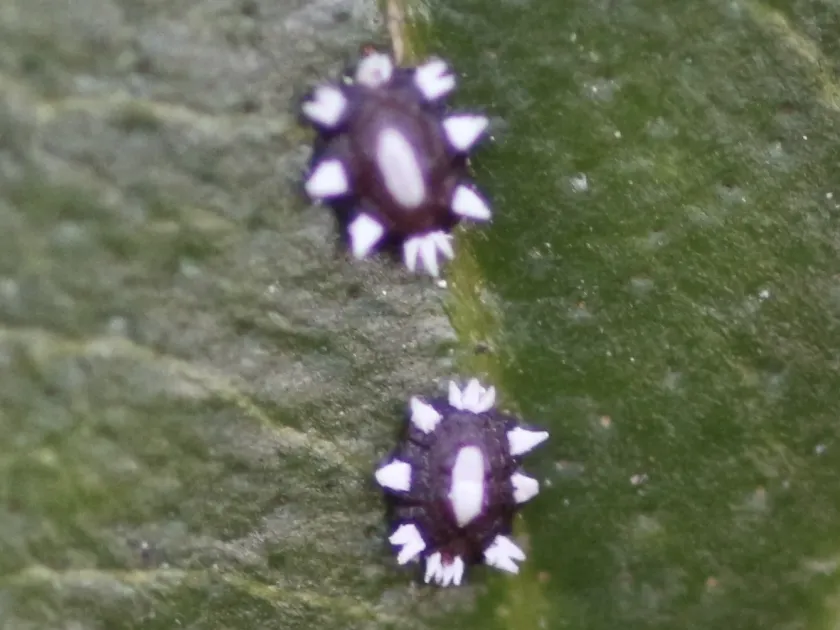
Description
How to identify
Wax scales are members of the Coccidae family (soft scales) within the order Hemiptera. They are characterized by a thick, waxy covering that protects the adult female, often making her appear as a hard, mound-like growth on the plant.
The female body is typically convex and hemispherical. The wax secretion can vary from white to pinkish or yellow, frequently camouflaging the insect as a resin droplet or a natural part of the stem.
These insects are sessile once they reach the adult stage, meaning they remain fixed in one position for the remainder of their lifespan. Their lifecycle includes eggs, crawlers (mobile first-instar larvae), and adults.
Unlike other insects, males are rare and play a negligible role in reproduction, which is often parthenogenetic. This allows a single female to establish a new colony on a plant.
Identification is challenging during the crawler stage because the larvae are tiny, translucent, and easily missed by visual inspection during the early phases of an infestation.
What it damages
Wax scales attack a diverse range of ornamental and fruiting plants, including citrus, figs, laurels, camellias, and various greenhouse-grown tropical species.
The insects feed by inserting their specialized mouthparts into the plant tissue to suck sap. This feeding process directly depletes the plant of nutrients and essential fluids.
Common symptoms of damage include stunted shoot growth, leaf yellowing, chlorosis, and premature leaf drop. The stress caused by feeding weakens the plant, making it susceptible to secondary infections.
A significant consequence of scale infestation is the production of copious amounts of honeydew. This sticky substance covers the leaves, hindering gas exchange and photosynthesis.
The honeydew provides an ideal substrate for the growth of sooty mold, a fungus that forms a black coating on leaves, further obstructing light and reducing the overall health of the plant.
When it appears
In indoor environments such as greenhouses and interiorscapes, wax scales can thrive and reproduce year-round, as they lack the distinct seasonal dormancy seen in field pests.
In outdoor subtropical climates, the peak crawler emergence usually coincides with warm, stable weather, which facilitates the rapid dispersal of the population across the host plant.
The rate of lifecycle completion is highly temperature-dependent. Increased warmth leads to faster maturation and multiple generations occurring within a single calendar year.
During cooler periods, the development slows down significantly, but the colony remains present, ready to resume rapid growth as soon as optimal temperatures return.
Agronomists recommend frequent inspections during the spring growth flush, as this is when the new generation of crawlers is most active and vulnerable to treatment.
Signs of infestation
The most prominent sign of infestation is the appearance of sticky honeydew on the upper surfaces of leaves and the ground below, which often leads to the growth of black sooty mold.
The presence of waxy, white or brown dome-like structures on stems, petioles, or along the midribs of leaves is a definitive indicator of an established scale colony.
Gradual yellowing of foliage and general plant decline, despite adequate watering and fertilization, indicates severe sap loss caused by the insects.
Small, translucent mobile spots (crawlers) visible on the underside of leaves or moving along stems suggest a new or active generation of pests.
Increased ant traffic on the plant is a strong indicator, as ants are attracted to the sugary honeydew produced by the scales and will often protect them from predators.
Control measures
Systemic insecticides are the most effective management tool, as they are absorbed by the plant and ensure that the insects ingest the toxin while feeding, bypassing their protective wax shield.
Manual removal of adult scales using a soft brush dipped in an alcohol solution is effective for minor infestations on houseplants and small decorative trees.
Horticultural oils, such as neem or mineral oils, work by suffocating the insects. These are particularly effective against the mobile crawler stage before they develop their protective wax layer.
Biological control using specific parasitoid wasps or ladybird beetles can significantly reduce wax scale populations in large greenhouse or conservatory settings.
- Regular monitoring of all plants for early detection;
- Isolation of newly introduced or infested plants;
- Pruning and destroying severely affected branches;
- Rotating chemical classes to avoid the development of insecticide resistance.
Taxonomy
- Latin name
- Ceroplastes
- Order
- Hemiptera (bugs, aphids, leafhoppers)
- Family
- Coccidae
- EPPO code
- CERPSP
Discussion
No discussions yet — be the first.