
Ceroplastes ceriferus
Ceroplastes ceriferus
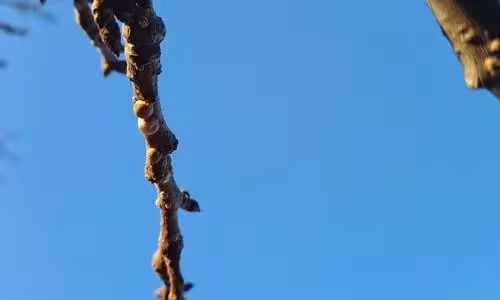
Description
How to identify
Ceroplastes ceriferus, commonly known as the white wax scale, is a species of soft scale insect in the family Coccidae. The most distinctive feature of the adult female is the thick, waxy covering that resembles a white or pinkish blob.
The waxy test serves as a heavy protective armor, shielding the soft-bodied insect underneath. Adult females can grow up to 5–8 mm in diameter, making them quite visible on the stems and leaves of host plants.
The insect goes through different life stages, starting from eggs protected under the female's wax, followed by the mobile crawler stage. Crawlers are tiny, oval, and pale, moving across the plant surface to find a suitable feeding spot.
This species is highly adapted to tropical and subtropical climates. In cooler regions, it is primarily found in greenhouses, conservatories, and as a houseplant pest, where it can thrive year-round due to stable temperatures.
Its ability to secrete wax makes Ceroplastes ceriferus a difficult pest to control. The waxy layer is essentially impervious to many standard contact insecticides, requiring more specialized management strategies.
What it damages
The white wax scale is a polyphagous pest, meaning it attacks a wide variety of plants. Common hosts include citrus, figs, hibiscus, camellias, and numerous other ornamental and fruit-bearing species.
The insects feed by inserting their piercing-sucking mouthparts into the phloem of the plant. They are commonly found clustering on twigs, leaf petioles, and along the veins on the undersides of leaves.
By constantly draining plant sap, the scale causes general plant vigor decline. Heavy infestations result in stunted shoot growth, chlorosis, and in extreme cases, the death of individual branches or even the entire plant.
As the insects feed, they excrete a large amount of sugary substance known as honeydew. This byproduct accumulates on the leaves, creating a sticky environment that attracts ants and facilitates the growth of sooty mold.
The combination of direct nutrient loss and the secondary damage caused by sooty mold significantly reduces the plant's aesthetic value and its overall health, leading to decreased yields in fruit crops.
Signs of infestation
The primary sign of an infestation is the presence of waxy, mound-like structures on branches or leaf surfaces. These look like small lumps of white or dirty-white wax that remain stationary.
Honeydew, appearing as a sticky, shiny residue on foliage, is a clear indicator of scale activity. Its presence often alerts growers to the existence of an infestation before the scales themselves are clearly seen.
Sooty mold, manifesting as a black, powdery layer on leaves, indicates that the scales have been present long enough to produce sufficient honeydew for fungal colonization, inhibiting photosynthesis.
Yellowing of leaves, leaf drop, and dieback of terminal growth are signs of an advanced infestation. When a plant reaches this state, the population of Ceroplastes ceriferus is likely very high.
The presence of ants patrolling the stems is also a strong indicator. Ants tend to the scale insects to protect them from predators in exchange for the honeydew, effectively acting as an early warning system.
Control measures
Managing the white wax scale requires a multi-faceted approach. For small plants or light infestations, physical removal using a soft brush or cloth dipped in soapy water or alcohol is effective.
Systemic insecticides are generally the most successful chemical control option. These products are absorbed by the plant and ingested by the scale, which bypasses the barrier provided by the waxy test.
Horticultural oils can be effective by suffocating the insects. These are often used when the crawler stage is active, as the younger scales have not yet developed their thick, impenetrable wax layer.
- Regular monitoring of plant material.
- Quarantining new plants before adding them to a collection.
- Using biological controls like parasitic wasps (e.g., Anicetus spp.).
- Improving plant vigor through proper nutrition and environmental control.
Timely treatment is essential. Once the scale has reached maturity and formed its thick waxy coating, control becomes significantly more difficult, requiring repeated applications or systemic treatments.
Taxonomy
- Latin name
- Ceroplastes ceriferus
- Order
- Hemiptera (bugs, aphids, leafhoppers)
- Family
- Coccidae
- EPPO code
- CERPCE
Discussion
No discussions yet — be the first.