

Description
How to identify
Soft scales belong to the family Coccidae and are a major group of sap-sucking pests that affect a wide variety of plants, including fruit trees, ornamentals, and greenhouse species.
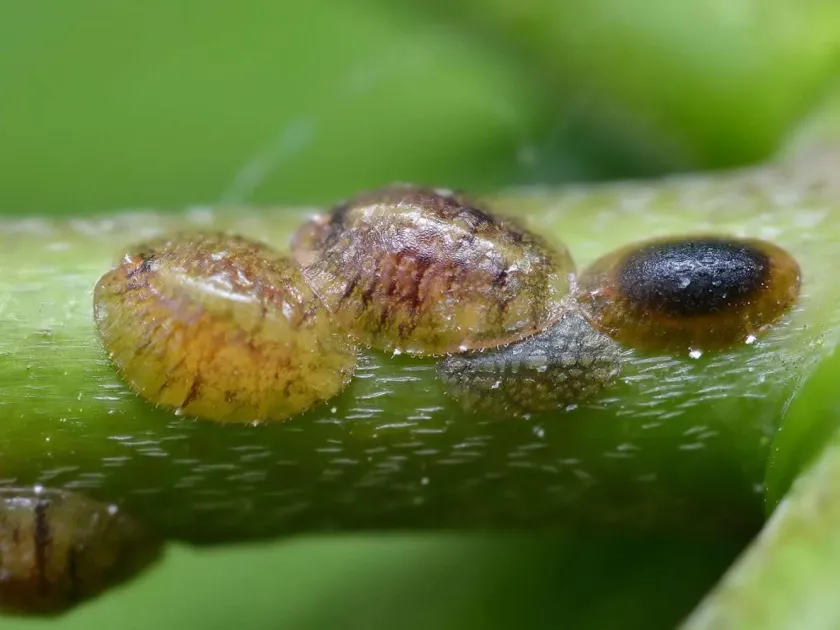
Unlike armored scales, soft scales do not produce a separate waxy shield; instead, their protective covering is a hardened, integral part of their own body wall, often appearing as a bump on stems.
Adult females are typically oval or hemispherical in shape, ranging from brown to reddish-brown in color. They are largely sedentary and remain attached to the plant surface throughout their reproductive life.
Males are rarely seen; they are small, winged, and do not feed, as their sole purpose is to fertilize the females before they die shortly after.
The first-instar nymphs, known as crawlers, are the only mobile stage of the pest. They are microscopic and move to new areas of the plant or onto neighboring plants to establish feeding sites.
What it damages
Soft scales feed by inserting their stylets into the plant's phloem and extracting sap, which deprives the plant of essential nutrients and weakens its overall physiological state.
The constant withdrawal of sap leads to stunted growth, yellowing leaves, and reduced vigor, which can eventually result in the death of the affected plant or individual branches.
As they feed, these insects excrete large quantities of honeydew, a sticky, sugary liquid that coats the leaves and stems, serving as an ideal environment for sooty mold to thrive.
The resulting sooty mold covers leaf surfaces with a dark film, effectively blocking photosynthesis and further stressing the plant’s health and productivity.
Severe infestations can cause premature leaf drop and make plants highly susceptible to secondary pests, pathogens, and winter cold damage.
When it appears
In most regions, soft scales overwinter as second-instar nymphs, often found clustered on the bark of twigs or sheltered in the crotches of branches where they remain dormant.
As temperatures rise in the spring, these nymphs resume feeding and develop into mature adults, beginning the cycle of reproduction for the new season.
Egg-laying usually occurs in late spring or early summer. A single female can produce hundreds of eggs, which are safely tucked beneath her body to protect them from environmental stress.
Crawler emergence typically happens in early summer. This is a critical period when the population disperses to new foliage and begins the cycle anew.
The number of generations per year varies significantly depending on the local climate and the specific species of soft scale, with some species producing multiple broods in warmer areas.
Signs of infestation
One of the most obvious signs is the appearance of unusual, raised bumps on stems and branches that feel like waxy or hard blisters on the bark.
Sticky residue on foliage, commonly known as honeydew, is a classic indicator that sap-sucking insects are present, even if the pests themselves are hidden.
The presence of a black, powdery-looking fungus called sooty mold on the surface of leaves is a clear secondary symptom of a heavy scale infestation.
Affected plants may show general signs of poor health, such as chlorosis (yellowing), wilting, or a failure to push out new growth during the active growing season.
- Raised brown or tan bumps on stems
- Sticky honeydew coating leaves
- Black sooty mold covering leaf surfaces
- Yellowing and premature leaf drop
- Stunted or deformed twig growth
Control measures
Good cultural practices, such as pruning out and destroying heavily infested branches, help to reduce the overall population pressure within the garden.
Dormant oil sprays applied in late winter or early spring are highly effective at suffocating overwintering nymphs before they become active in the spring.
When crawlers are active, systematic insecticides can be applied to provide effective control, as this is the stage where the insects have not yet developed their protective covering.
Encouraging natural predators, such as lady beetles, lacewings, and parasitic wasps, can provide significant biological control and keep scale populations at manageable levels.
Regular monitoring of plants, particularly during early summer, is essential to detect the mobile crawler stage and take timely action before the infestation spreads further.
Content graph
Connections · Soft scale
Most often together:
Marketplace
Products · 6


Biology
Taxonomy
- Latin name
- Coccus
- Order
- Hemiptera (bugs, aphids, leafhoppers)
- Family
- Coccidae
- EPPO code
- COCCSP
Community
Discussion
No discussions yet — be the first.