

Pest · Orthoptera (locusts) · affects Potato, Tomato, Wild cabbage
Especially harmful
European mole cricket
Gryllotalpa gryllotalpa
Description
How to identify
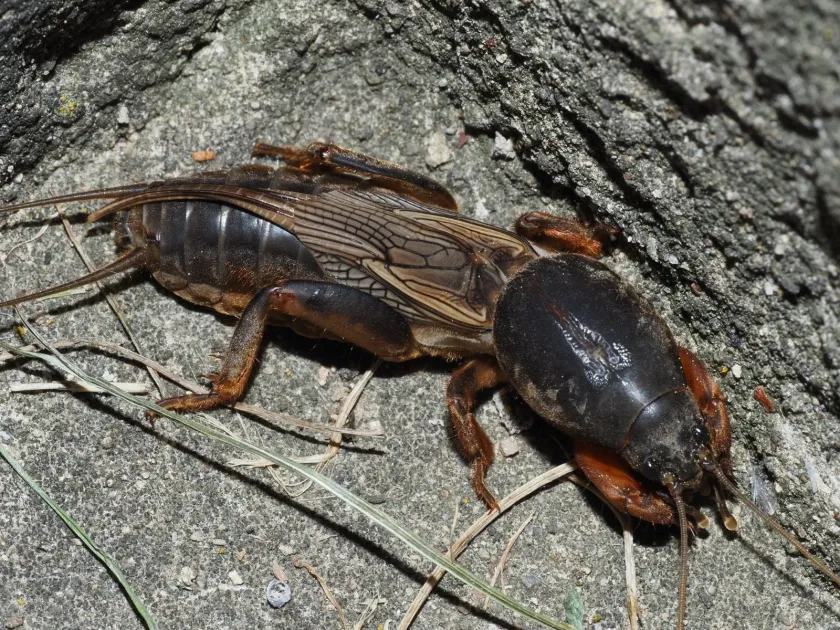
The European mole cricket (Gryllotalpa gryllotalpa) is a member of the order Orthoptera and the family Gryllotalpidae. Adults grow to 35–50 mm, featuring a brown armored exoskeleton and specialized fossorial forelegs.
This insect is primarily subterranean but is capable of flight during dusk and is a proficient swimmer. Its body is adapted for pushing through dense soil, with a hard head and prothorax.
The life cycle involves incomplete metamorphosis and typically lasts 1 to 2 years, heavily dependent on soil temperature and regional climate.
Females create subterranean brood chambers 10–20 cm deep, laying up to 300 eggs. Nymphs hatch as miniature versions of adults but lack functional wings.
Throughout their development, nymphs undergo several molts, gradually increasing in size and developing full morphological features, including wing pads.
What it damages
The mole cricket is a polyphagous pest, causing significant damage to a wide range of vegetable, grain, and ornamental crops across various agricultural landscapes.
Seedlings of tomatoes, peppers, cabbages, and eggplants are particularly vulnerable, as are root crops like carrots, beets, and potatoes.
The pest shears through roots and stems underground, while also consuming germinating seeds, leading to severe thinning of crop stands.
Damage to the root system interrupts water and nutrient uptake, causing rapid wilting and eventual death of the affected plants.
Under high population pressure, mole crickets can destroy a vast majority of a harvest within a short period, leading to substantial economic losses.
When it appears
Activity commences in early spring as soil temperatures rise to 10–12°C, prompting the insects to emerge from their deep wintering sites.
The mating and egg-laying period peaks in May and June, during which time the insects are highly mobile as they seek out food sources and mates.
Summer is characterized by the intense feeding activity of nymphs of various stages, which actively tunnel and forage in the upper soil layers.
As autumn approaches and temperatures drop, mole crickets migrate to deeper soil profiles to prepare for overwintering.
Overwintering occurs in diapause within deep burrows, compost heaps, or manure piles that provide thermal insulation against freezing temperatures.
Signs of infestation
The primary visual sign of infestation is the presence of winding surface tunnels, appearing as raised ridges of loose soil across garden beds.
Sudden, unexpected wilting of healthy-looking seedlings or mature plants usually indicates that roots have been severed beneath the surface.
Patches of missing seedlings in otherwise uniform rows are a clear indicator of mole cricket feeding activity during germination.
Brood chambers can be discovered during tillage, appearing as dense, compacted soil balls that contain eggs or clusters of developing nymphs.
The distinct, chirping sound produced by males during evening hours serves as a reliable auditory indicator of a present infestation.
Control measures
Managing the European mole cricket requires an integrated pest management (IPM) strategy that combines physical and chemical control methods.
- Deep autumn tillage to destroy tunnel networks and expose the insects to predators and cold.
- Using manure-filled pit traps in early spring to capture overwintered adults.
- Applying insecticidal baits in accordance with local regulations for crop protection.
- Utilizing biological control agents, such as Beauveria bassiana, to target the pest population.
- Planting repellent crops like marigolds to discourage infestation in specific areas.
Content graph
Connections · European mole cricket
Most often together:
Weeds
1 contact
Marketplace
Products · 30
All 30
Insecticides, Acaricides 24
Biological Products 1
Sunflower 1
Rye 1
Corn 1
Garlic 1
Tagetes 1


Antikhrushch
ТОВ «Фабрика агрохімікатів», Черкаси, Україна
Insecticides
0
0
·
94
140 offers
12.07 €per 1 l
Buy

Nuprid 600, c.s. (imidacloprid, 600 g/l)
Нуфарм Австралія Лтд. , Австралія (місце виробництва: Чілі
Insecticides
0
0
·
76
1 offer
52.6 €per 1 l
Buy

Antixrush k.s.
«Нанджин Ессенс Файн-Кемікал Ко. Лтд» (Китай)
Insecticides
0
0
·
72
1 offer
28.67 €per 1 l
Buy


RembeK ONE
Innovative company "Agro Protection", LLC
Insecticides
0
0
·
58
3 offers
0.84 €per 1 l
Buy

ANTICHROSH LUX
ТОВ «Фабрика агрохімікатів», Черкаси, Україна
Insecticides
0
0
·
52
4 offers
3.14 €per 1 l
Buy

RembeK Duo
Innovative company "Agro Protection", LLC
Insecticides
0
0
·
50
22 offers
0.95 €per 1 l
Buy

Insecticide Anti Khrushch, SC (imidacloprid, 100 g/l + bifenthrin, 100 g/l)
«Нанджин Ессенс Файн-Кемікал Ко. Лтд» (Китай)
Insecticides
0
0
·
50
2 offers
36.76 €per 1 l
Buy


Insecticide of biological origin «Entocide (Metarizin)
BTU-Center
Insecticides
0
0
·
41
49 offers
3.97 €per 1 l
Buy

Rembek
Scientific-Production Company "Kvadrat", LLC
Insecticides
0
0
·
30
116 offers
0.74 €per 1 l
Buy


Biology
Taxonomy
- Latin name
- Gryllotalpa gryllotalpa
- Order
- Orthoptera (locusts)
- Family
- Gryllotalpidae
- EPPO code
- GRYTGR
Community
Discussion
No discussions yet — be the first.