
Short-winged mole cricket
Scapteriscus abbreviatus
Description
How to identify
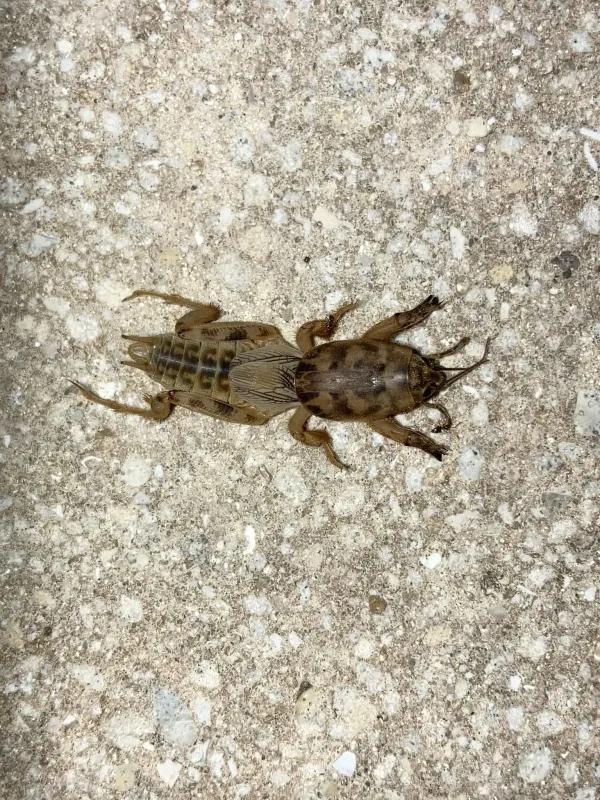
The short-winged mole cricket, Scapteriscus abbreviatus, belongs to the Gryllotalpidae family within the order Orthoptera. It is morphologically similar to other mole cricket species but is distinguished by its shorter wings that do not extend to the tip of the abdomen.
These insects are well-adapted for a subterranean lifestyle, possessing enlarged, shovel-like forelegs designed for rapid burrowing through soil. Their bodies are protected by a tough, brown-colored exoskeleton that prevents abrasion during movement.
The species undergoes incomplete metamorphosis, consisting of egg, nymph, and adult stages. Throughout their lifecycle, they remain primarily within the upper soil layers, rarely venturing far above ground.
Due to their flight limitations compared to other mole crickets, local populations are often denser and remain concentrated in moist, organic-rich environments such as turfgrass, garden beds, and moist meadows.
Sensory organs on their antennae and cerci allow them to navigate effectively in the darkness of the soil, detecting vibrations and chemical signals from food sources or potential mates.
What it damages
As a polyphagous pest, the short-winged mole cricket causes severe damage to various crops. It commonly targets vegetable crops, including tomatoes, peppers, cabbages, and root vegetables like carrots and potatoes.
Turfgrass is a major target, where the cricket's burrowing action severs roots and loosens the soil, causing grass to wilt and eventually die. This leads to large, unsightly brown patches in lawns and golf courses.
Young fruit tree saplings and ornamental plants in nurseries are also at risk. The larvae and adults feed on tender root systems, which significantly stunts the growth of the plants or results in total loss.
In addition to direct feeding, the mechanical damage caused by their burrowing systems disrupts water and nutrient uptake. This creates stress on the plants, making them susceptible to drought and secondary pathogens.
The tunnels created by the mole cricket also expose roots to air, leading to dehydration. Furthermore, these channels provide entry points for soil-borne diseases such as root rot and bacterial infections.
When it appears
Activity typically increases in spring as soil temperatures rise, prompting the crickets to move closer to the surface from their deeper overwintering locations. This is when they begin their primary feeding cycles.
The peak reproductive period usually occurs during the summer months. During this time, females lay clusters of eggs in underground chambers, and the resulting nymphs actively forage for food.
Nymphs continue to feed throughout the summer and early autumn. Their voracious appetite during these developmental stages is responsible for significant portions of the damage observed in late-season crops.
As autumn progresses and soil temperatures drop, both adults and nymphs move deeper into the soil profile to avoid freezing conditions, remaining dormant until the following spring.
In warmer climates or greenhouses, the activity season may be extended, allowing for multiple generations or a near-continuous feeding cycle that complicates pest management efforts.
Signs of infestation
A primary indicator of a mole cricket infestation is the presence of irregular, winding ridges of displaced soil on the surface, which look like small raised tunnels after rainfall or irrigation.
Plants may suddenly exhibit signs of yellowing or wilting, despite regular watering. If pulled, these plants often come out easily, revealing that their root systems have been completely chewed off.
The appearance of small, circular holes (about 1–2 cm in diameter) in the soil surface is a strong indicator of active tunneling and emergence points used by the mole crickets.
In turfgrass, patches of grass may feel spongy when walked upon, as the crickets have created extensive networks of tunnels beneath the root zone, detaching the grass from the soil.
Nighttime observation with a flashlight may reveal adults on the surface. Additionally, their characteristic chirping sound, often heard in the evening, can signal their presence in the area.
Control measures
Cultural control practices include deep plowing in the autumn to disrupt overwintering sites and destroy egg chambers. Maintaining healthy, compact soil can also inhibit tunneling.
Chemical control often involves the use of targeted insecticide baits. These are typically applied in the late afternoon or evening when the crickets are most active near the soil surface.
Biological control agents, such as the entomopathogenic nematode Steinernema scapterisci or parasitic wasps, have shown effectiveness in suppressing population numbers in specific regions.
Monitoring using soapy water flushes can help identify hotspots, allowing for localized treatments rather than blanket applications, which helps preserve beneficial soil fauna.
- Regular mowing and irrigation management to reduce favorable conditions.
- Installation of physical barriers for high-value seedlings.
- Use of botanical repellents like castor oil-based formulations to deter tunneling.
Taxonomy
- Latin name
- Scapteriscus abbreviatus
- Order
- Orthoptera (locusts)
- Family
- Gryllotalpidae
- EPPO code
- SCAEAB
Discussion
No discussions yet — be the first.