
Six-fingered mole cricket
Neocurtilla hexadactyla
Description
How to identify
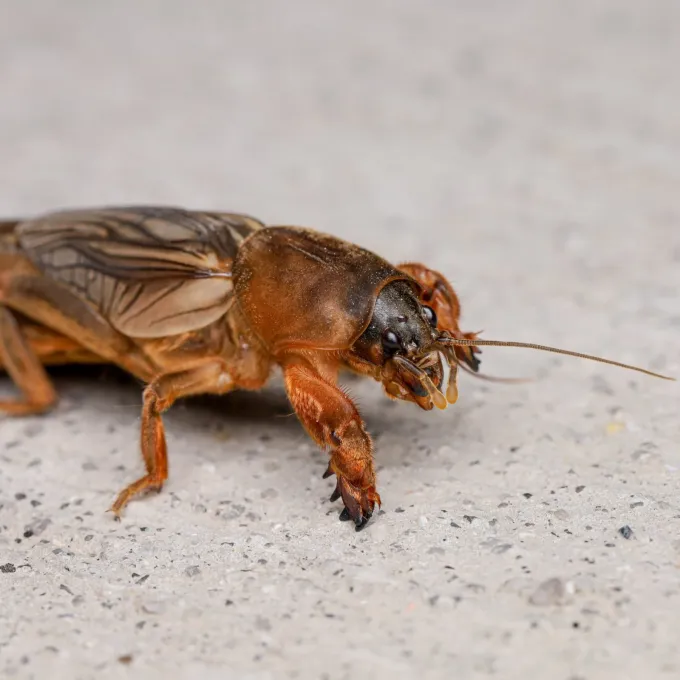
The six-fingered mole cricket (Neocurtilla hexadactyla) belongs to the family Gryllotalpidae, order Orthoptera. These insects are easily recognized by their stout, brownish, velvet-covered bodies, typically measuring 30–35 mm in length.
The most distinctive feature of this species is its modified front legs, which are specifically adapted for tunneling through the soil. These legs feature six tooth-like dactyls (projections), distinguishing them from other mole cricket species.
Their life cycle is almost entirely subterranean. Females create specialized brood chambers in the soil, usually 10–20 cm deep, where they lay their eggs and guard the developing nymphs until they reach a certain level of maturity.
Depending on environmental conditions, the development from egg to adult can take one to two years. Nymphs resemble miniature adults but lack wings, gradually growing larger and more destructive through several molting stages.
These insects are primarily active at night and are highly sensitive to soil temperature. In winter, they retreat deep into the soil to hibernate, re-emerging in the spring as soon as the ground warms up sufficiently for foraging.
What it damages
The six-fingered mole cricket is a voracious polyphagous pest that attacks a wide variety of cultivated crops. Common targets include vegetable staples like potatoes, tomatoes, peppers, cabbage, eggplants, and carrots.
Beyond vegetables, this pest frequently damages the root systems of young nursery seedlings, fruit trees, and various ornamental plants, leading to severe stunted growth or rapid plant death.
Damage occurs primarily through the physical destruction of root systems and stems. By chewing through underground plant parts, the insect prevents the uptake of water and nutrients, causing the plant to wilt and collapse within a few days.
The tunneling activity itself causes secondary damage. The creation of large subterranean voids promotes soil desiccation, leaving roots exposed to air and causing them to dry out prematurely, which can ruin entire rows of crops.
In protected cultivation environments like greenhouses, the damage can be catastrophic. The loose soil and constant moisture provide an ideal habitat for these insects, allowing them to destroy a large portion of a crop yield in a very short time.
Signs of infestation
The most obvious sign of an infestation is the presence of winding, raised ridges on the soil surface, which become particularly visible after rain or irrigation when the ground settles.
Sudden wilting of healthy-looking plants is a major red flag. If a plant can be pulled out of the ground with almost no resistance and appears to have no roots, it is a clear indicator of mole cricket activity.
When harvesting root vegetables like carrots or potatoes, you may find large, hollowed-out cavities or ragged bite marks, which are signature signs of the strong, serrated mandibles of the six-fingered mole cricket.
During the warmer months, particularly at dusk, you may hear the distinctive chirping sound produced by males to attract females. Locating the source of this sound often reveals high-density areas of the pest population.
Surface soil that feels excessively soft or "honeycombed" with small holes indicates an active infestation, making it difficult for seeds to germinate properly as they may fall into tunnels instead of taking root.
Control measures
Effective management begins with deep tillage in the autumn. This process physically disrupts the insects' burrows, destroying brood chambers and exposing nymphs and adults to surface predators and cold temperatures.
Springtime trapping using manure piles is a highly effective cultural control method. The heat generated by decomposing manure attracts the crickets for nesting, allowing gardeners to easily collect and destroy the insects within the traps.
Chemical control can be implemented using specialized baits or soil drenches containing active ingredients like fipronil or imidacloprid. These must be applied carefully according to local regulations to minimize impact on non-target species.
Physical barriers offer excellent protection for high-value seedlings. Placing plastic collars or wire mesh cages around the root zone at planting time prevents the mole crickets from reaching and severing the young stems.
Biological control using entomopathogenic nematodes or fungi is an increasingly popular approach. These natural enemies infect the mole crickets in their tunnels, significantly reducing population levels without introducing synthetic chemicals into the garden soil.
Taxonomy
- Latin name
- Neocurtilla hexadactyla
- Order
- Orthoptera (locusts)
- Family
- Gryllotalpidae
- EPPO code
- GRYTHE
Discussion
No discussions yet — be the first.